The Socio-economic Shield Limits Lassa Virus Spillover in Urban West Africa
Read the preprint
Background
Spatial risk models for Lassa fever generally predict that the primary reservoir, Mastomys natalensis, is restricted to rural landscapes, relying heavily on abiotic climatic envelopes. However, the rapid expansion of West African cities fundamentally alters local rodent dynamics through anthropogenic land-use shifts and novel multi-species competition.
This study reconstructs the reservoir’s realised niche by implementing an Integrated Multi-Species Occupancy Model (IMSOM). This framework explicitly quantifies co-occurrence dynamics between M. natalensis and invasive commensals (Rattus rattus, Mus musculus) to correct the “urban blind spot” present in previous forecasting efforts. Furthermore, it introduces a “socio-economic shield”—proxied by nighttime lights—to model the non-linear dampening effect of urban infrastructure on zoonotic spillover.
Key Findings
By integrating multi-species biotic interactions and anthropogenic land-use into a high-resolution framework, the model demonstrates that Lassa fever possesses the biological potential to become a peri-urban disease.
- Cryptic Urban Reservoir Niche: Accounting for species interactions reveals that M. natalensis exhibits high ecological tolerance for peri-urban and human-modified landscapes, actively persisting alongside invasive competitors rather than facing strict competitive exclusion.
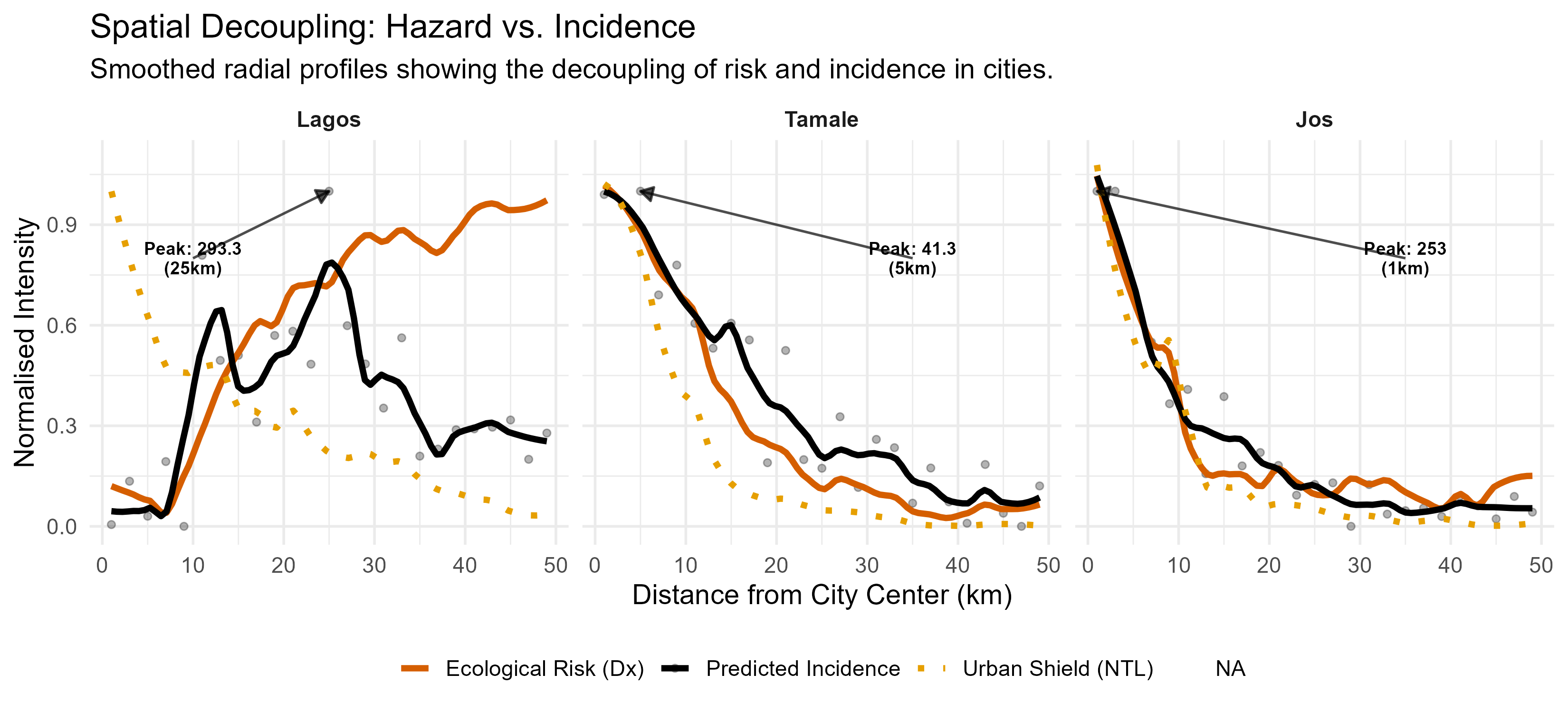
- The Socio-economic Shield: Urban infrastructure acts as a physical barrier, decoupling biological hazard from realised human spillover. While the biological hazard remains high in the peri-urban fringes, dense urban cores remain shielded from intense transmission.
- Revised Infection Burden: Adjusting for empirically modelled antibody waning (seroreversion) and spatial urban shielding yields an estimated regional burden of 2.6 million annual Lassa virus infections.
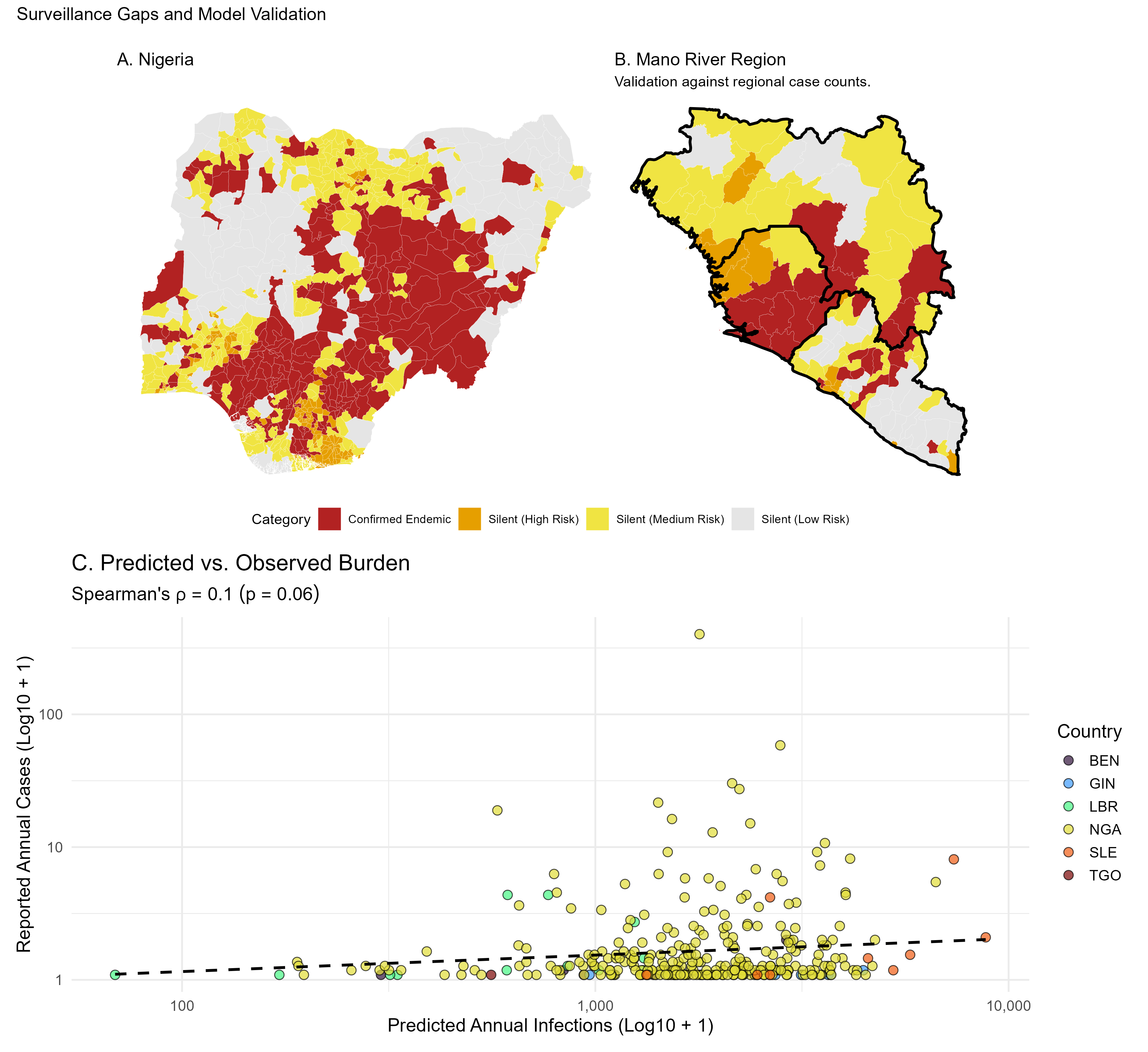
- Identification of Silent Districts: Spatial validation against clinical data identifies highly suitable “silent districts” in Nigeria, Benin, and Togo. These top-quartile incidence areas report zero cases, exposing profound surveillance gaps actively produced by structural inequalities rather than an absence of biological hazard.
Visualising the Risk Dynamics
Citation
@online{simons2025,
  author = {Simons, David},
  title = {The {Socio-economic} {Shield} {Limits} {Lassa} {Virus}
    {Spillover} in {Urban} {West} {Africa}},
  date = {2025-12-17},
  langid = {en}
}