Project ArHa: Arenaviruses & Hantaviruses
A global synthesis of rodent-borne viral pathogens
Project ArHa brings together published records of small mammals sampled for arenaviruses and hantaviruses, worldwide. I lead it with Stephanie Seifert, with support from the Fellows-in-Residence programme of the Verena consortium, and in collaboration with David Redding and his group at the Natural History Museum in London.
Each record gives the species sampled, the place and date, the assays used and their results. Records where no animal tested positive are retained in the database, so it describes sampling effort as well as detection. That is what makes the biases in surveillance measurable.
54,865 host sampling records in the v1.1 release
103 countries with sampling records
46% of rodent genera never sampled for these viruses
Use the data
- Release. Version 1.1 is archived on Zenodo, doi:10.5281/zenodo.21978983. To cite all versions, use the concept DOI 10.5281/zenodo.21978982.
- Explore. The ArHa database explorer filters records by virus, host and region.
- Code and data dictionary. The GitHub repository holds the extraction and cleaning code and the data dictionary. It is released under CC0.
- Methods. The search strategy, extraction criteria and database structure are in the published protocol, doi:10.12688/wellcomeopenres.24037.2. A data paper describing the release is in preparation.
Where hosts have been sampled
Host sampling records per hexagon
Loading the sampling record.
A record is one host species sampled at one place and time. Records where no animals of that species were caught still count, so a hexagon can hold more records than individuals.
Drag to rotate, or focus the globe and use the arrow keys. The records themselves are in the ArHa database explorer.
Show as a table
| Continent | Country | Records | Locations | Individuals |
|---|
Host status and surveillance bias
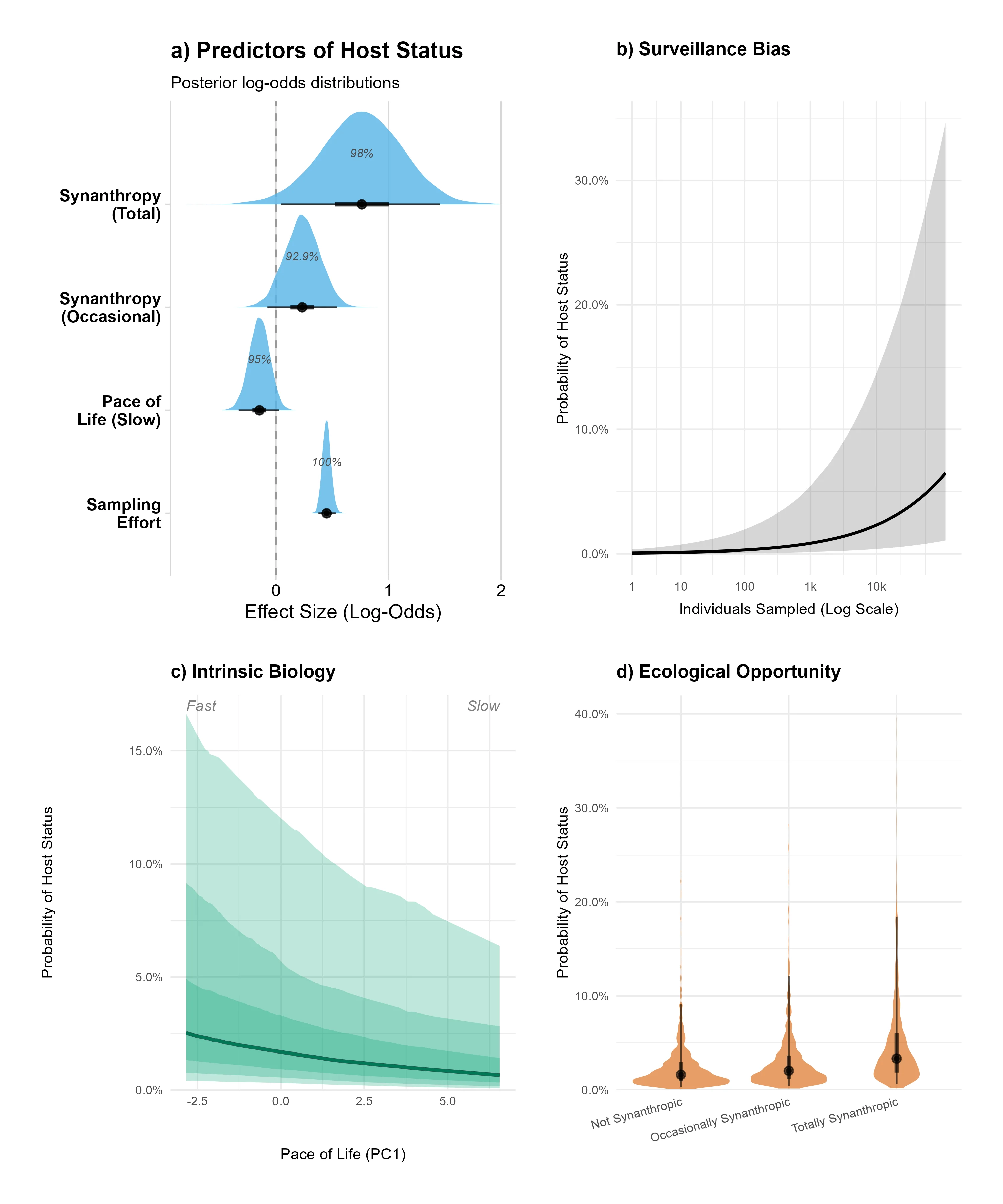
Host status for arenaviruses and hantaviruses appears to track synanthropy and a fast pace of life. Surveillance is not random, so these associations could be artefacts of where and what has been sampled. The ArHa preprint uses the database’s record of sampling effort to assess whether host status is predictable once that effort is accounted for.
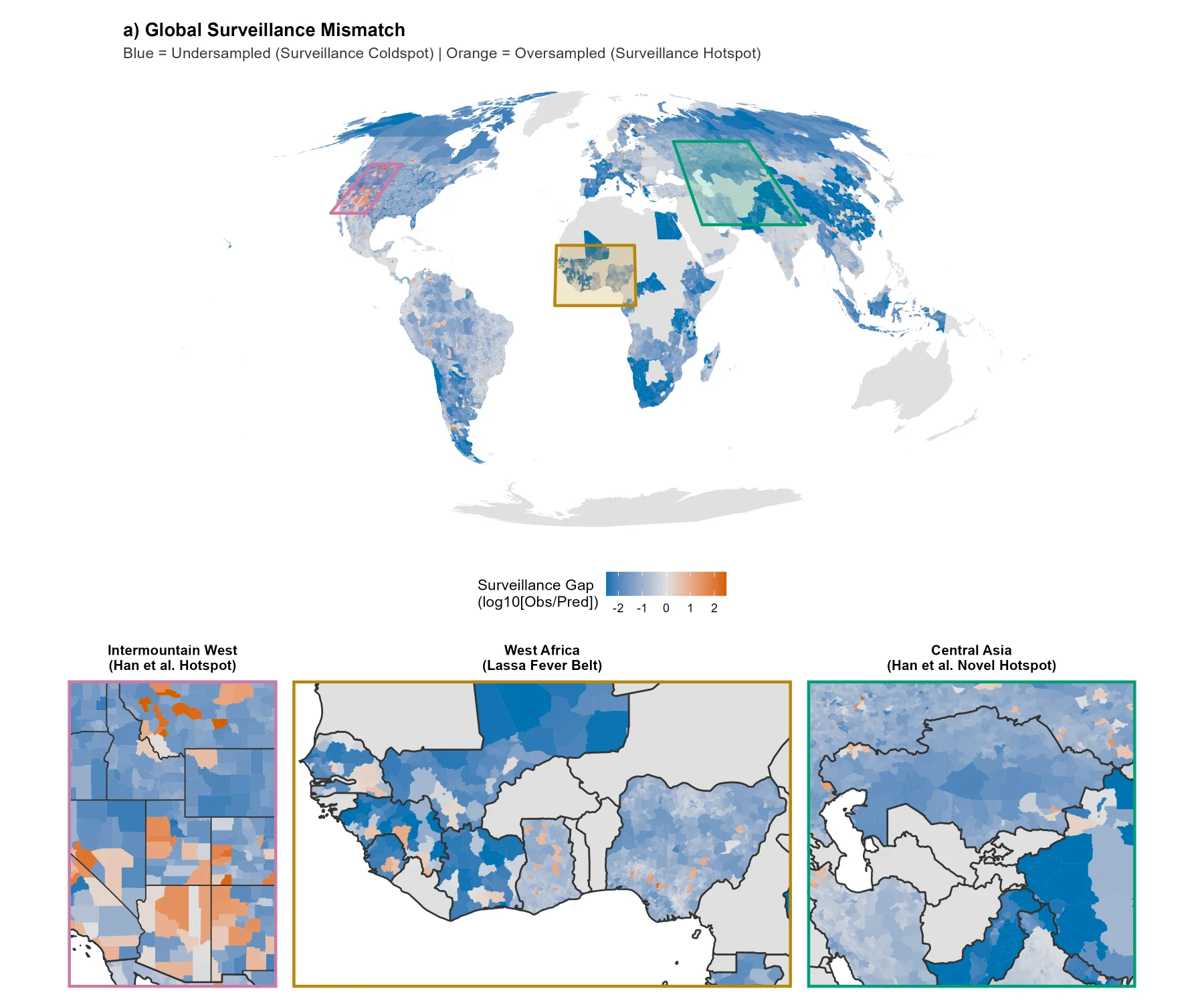
Surveillance intensity follows night-time light intensity and accessibility, not local host richness. Forty-six per cent of rodent genera have never been sampled.
Bayesian phylogenetic mixed models of 43,677 host–virus pairs estimate host status after adjusting for sampling effort. Faster-lived species tended to be detected as hosts more often, though the credible interval included zero. Synanthropy was independently associated with host status, with about twice the odds for obligate commensals. Withheld continents were predicted with an AUC of 0.81 to 0.88.
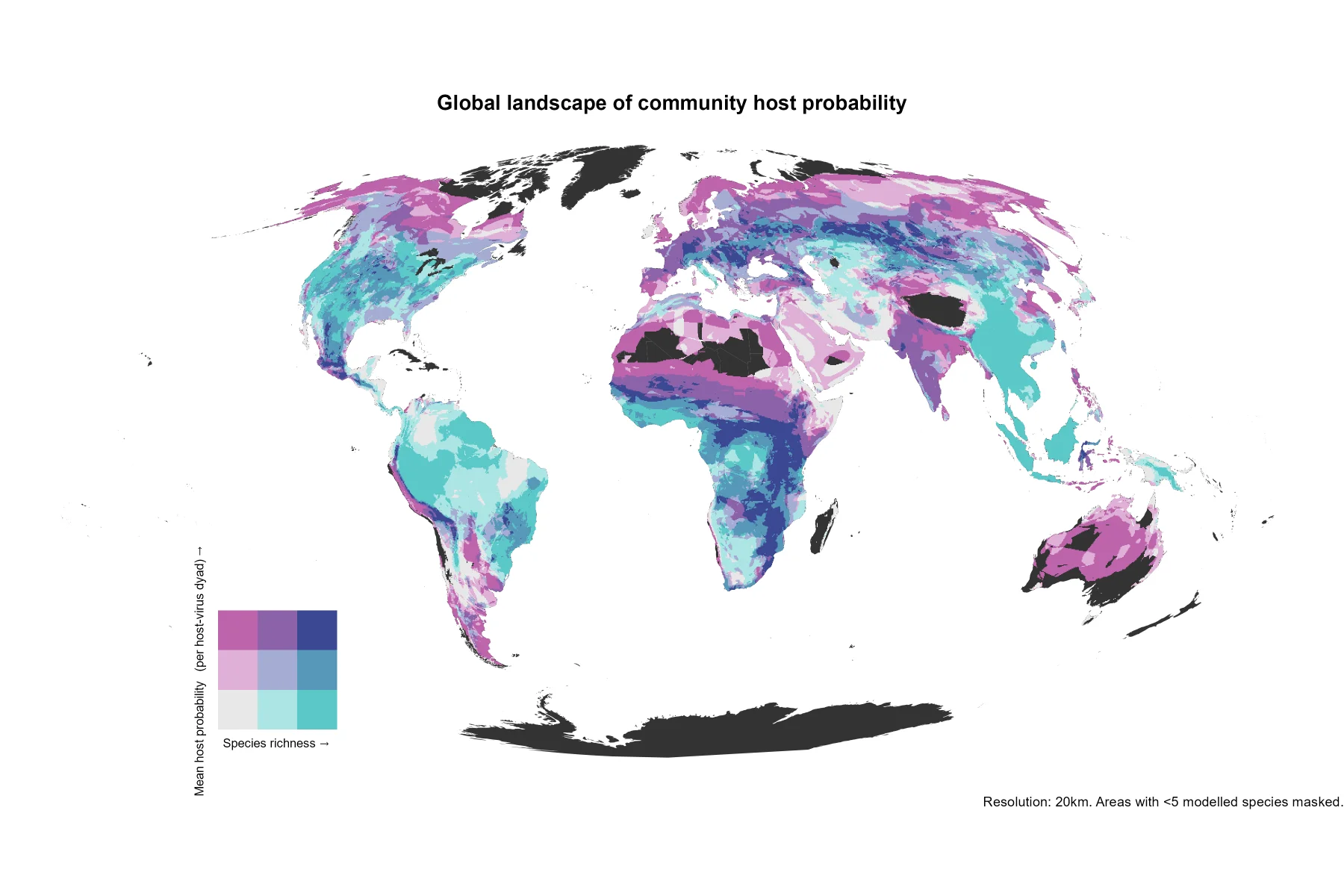
Projected globally, community host probability varies largely independently of species richness (R² = 0.028). Diverse assemblages do not carry systematically higher host probability.
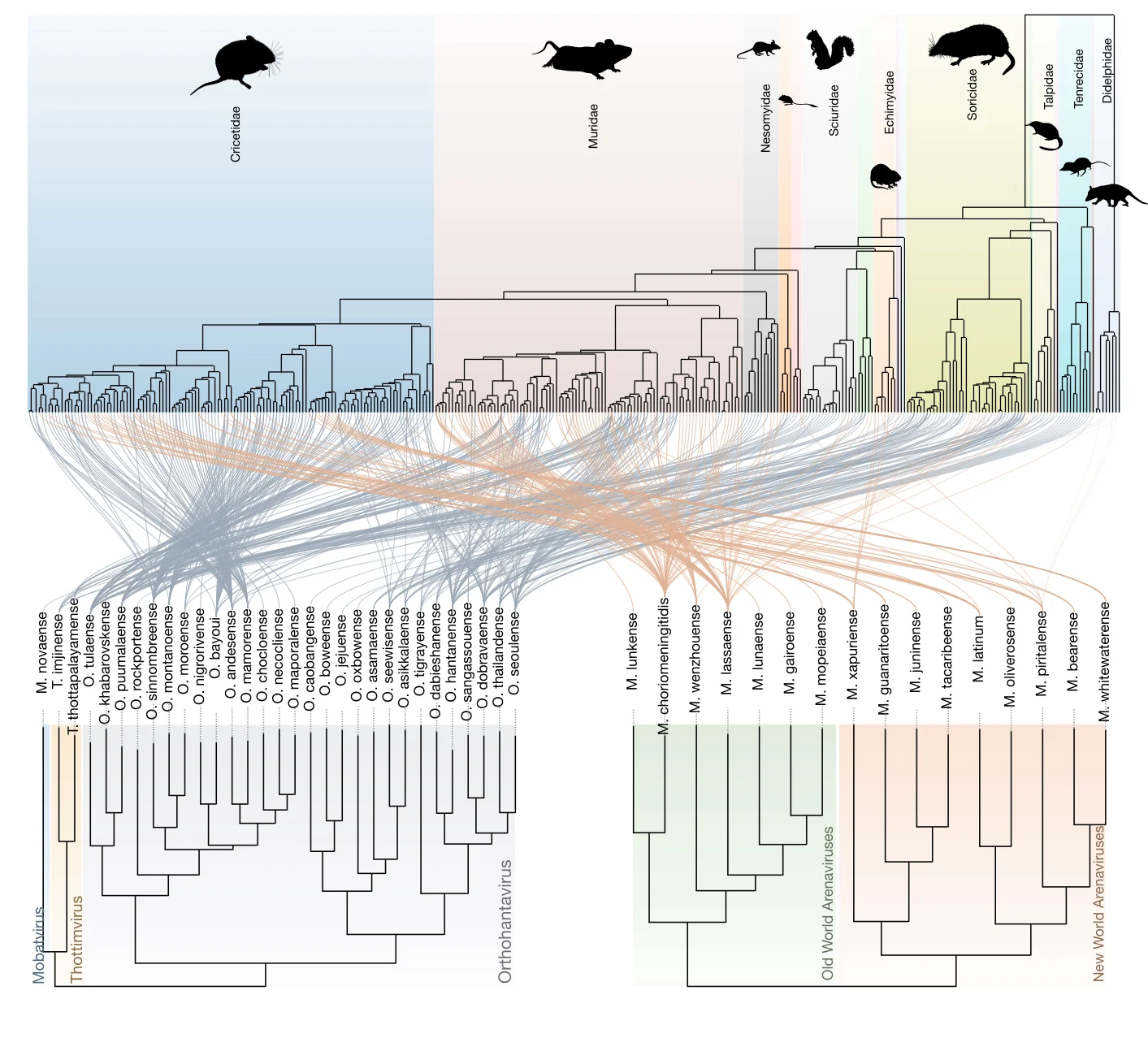
Host and virus phylogenies are congruent in both families, but most associations depart from strict co-divergence. Host switching has occurred alongside shared evolutionary history.
Papers
Molecular and ecological determinants of effective reassortment in orthohantaviruses
Rivero R, Simons D, Damodaran L, Karegi I, Gurev S, Becker DJ, et al.
Preprint, 2026 · PDF (preprint)
Summary
Segmented RNA viruses can exchange whole genome segments when two lineages infect the same host, but most reassortants never establish. Why some persist and others do not is an open problem in viral evolution, and orthohantaviruses offer a tractable case because host associations are well described.
Reassortant histories were reconstructed across 553 genomes from seven orthohantavirus species sampled between 1983 and 2024, using phylogenetic reconciliation and molecular dating, then modelled with Bayesian hierarchical models. Retained reassortment varied by species, absent in Andes virus and frequent in Dobrava-Belgrade, Sin Nombre, Seoul, Puumala and Tula viruses, so it is not a genus-wide constant. Local host overlap was the strongest ecological correlate, while cross-segment linkage and terminal RNA structure acted as a molecular filter.
Establishment was most probable where ecological opportunity coincided with molecular permissiveness, their interaction being the strongest signal in the establishment models (posterior probability 0.97). Reassortment therefore appears to be sequentially filtered: lineages must first meet in a host, then exchange compatible segments, then land in a lineage background that permits establishment.
Viral reservoir status in small mammals emerges as a predictable life-history trait after correcting for surveillance bias
Simons D, Rivero R, Rickard G, Martinez-Checa A, Gordon H, Redding DW, Seifert SN
Preprint, 2026
Summary
Small mammals are the principal hosts of arenaviruses and hantaviruses, but global surveillance is non-random, so the determinants of host status remain contested. Associations with synanthropy or life history could reflect where and which species have been sampled rather than host biology.
Using the ArHa database, 729 studies and 695,000 diagnostic assays across 637 species were harmonised. Surveillance intensity followed night-time light intensity and accessibility rather than local host richness, and 46% of rodent genera have never been sampled. Bayesian phylogenetic mixed models of 43,677 host–virus pairs, adjusted for sampling effort, estimate that faster-lived species tended to be detected as hosts more often, though the credible interval included zero (pd 93.2%). Synanthropy was independently associated with host status, with obligate commensals at about twice the odds. Predictions discriminated hosts in withheld continents (AUC 0.81 to 0.88).
Projected globally, community host probability varied largely independently of species richness (R² = 0.028). Host and virus phylogenies were congruent, with host switching alongside co-divergence.
Protocol to produce a systematic Arenavirus and Hantavirus host-pathogen database: Project ArHa.
Simons D, Rivero R, Guiote AMC, Gordon HLM, Milne GC, Rickard G, Redding DW, Seifert SN
Preprint, 2025 · Wellcome Open Research, 2025 · PDF
Summary
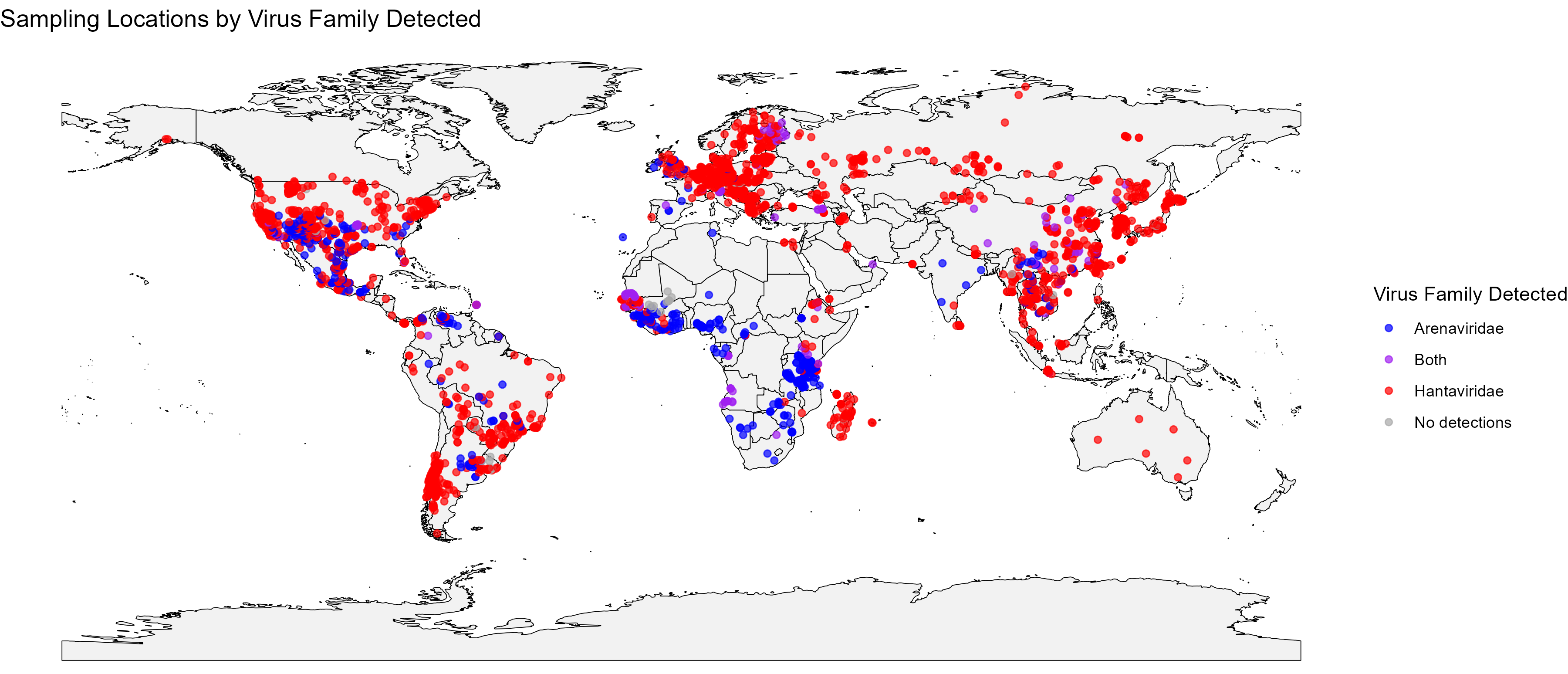
Arenaviruses and hantaviruses are hosted primarily by rodents and shrews and cause substantial human morbidity, yet their global distribution is known only through a literature scattered across decades, languages and disciplines. Without a synthesis, sampling effort cannot be separated from pathogen occurrence.
This protocol specifies how Project ArHa assembles that synthesis: the search strategy across bibliographic databases, screening and inclusion criteria, extraction fields, and a relational structure of five tables covering citations, study design, host occurrence, pathogen assay and genetic sequence. Critically, non-detections are retained, so absence of virus in a sampled host is recorded rather than lost.
The resulting database is spatially and temporally explicit, which makes it usable for quantifying surveillance bias as well as for modelling host-pathogen association. An accompanying Shiny application opens the data to users who do not code. The protocol was published before extraction completed, fixing the method in advance.
Last updated 6 October 2026