| Common name | Scientific name | Country | References |
|---|---|---|---|
| Virus Isolation | |||
| Rope squirrel | Funisciurus anerythrus | Democratic Republic of Congo (DRC) | Khodakevich et al. 1986 |
| Sooty mangabey | Cercocebus atys | Cote d'Ivoire | Radonić et al. 2014 |
| Antibody Detection | |||
| Rope squirrel | Funisciurus anerythrus | DRC, Ghana, | Reynolds et al. 2010 |
| Giant pouched rats | Cricetomys emini | Ghana, DRC | Reynolds et al. 2010 |
| Sun squirrels | Heliosciurus spp. | Ghana | Reynolds et al. 2010 |
| Elephant shrews | Petrodromus tetradactylus | DRC | Hutin et al. 2001 |
| Domestic pigs | Sus scrofa | DRC | Hutin et al. 2001 |
| African dormouse | Graphiurus lorraineus | DRC | Doty et al. 2017 |
| Rusty-nosed rat | Oenomys hypoxanthus | DRC | Doty et al. 2017 |
| Grivet | Cercopithecus aethiops | Cote d'Ivoire, Liberia, Ghana, Mali | Breman et al. 1977 |
| Mona monkey | Cercopithecus mona | Cote d'Ivoire, Liberia, Ghana, Mali | Breman et al. 1977 |
| Lesser spot-nosed monkey | Cercopithecus petaurista | Cote d'Ivoire, Liberia, Ghana, Mali | Breman et al. 1977 |
| Greater spot-nosed monkey | Cercopithecus nictitans | Cote d'Ivoire, Liberia, Ghana, Mali | Breman et al. 1977 |
| Western red colobus | Colobus badius | Cote d'Ivoire, Liberia, Ghana, Mali | Breman et al. 1977 |
| King colobus | Colobus polykomos | Cote d'Ivoire, Liberia, Ghana, Mali | Breman et al. 1977 |
Surveillance and outbreak response
Where to sample, and what to do when something is already spreading
Surveillance
One Health
Outbreak Response
Surveillance is a resource allocation problem before it is a laboratory one. Sampling wildlife is expensive, so the question is where a sample changes what we know. Outbreak response is the same question under time pressure.
Wildlife disease surveillance
A protocol for biodiversity-informed wildlife disease surveillance sets out where to sample. Host species distribution models set a biodiversity dose, uncertainty identifies where discovery sampling would help most, and balanced-acceptance sampling turns the result into field sites. The case studies are Hantaviridae and Arenaviridae in India and South Korea.
The Vetenskapsrådet South Korea–Sweden research collaboration grant An AI-directed One Health risk prediction framework for active learning in rodent-borne zoonoses takes the South Korea case study forward, from October 2026 to December 2027. I lead it from Uppsala University, with Chungnam National University as the Korean partner. Landscape embeddings from Earth-observation imagery describe habitat, Bayesian spatial models downscale host hazard to human incidence, and an active-learning step directs rodent sampling to sites where a new sample would most reduce uncertainty and that a field team can reach.
A protocol for biodiversity-informed wildlife disease surveillance
Catchen MD, Banville F, Boutin AC, Brookson CB, Carlson CJ, Dansereau G, …, Simons D, et al.
Preprint, 2025 · PLOS Ecosystems, 2026 · PDF
Summary
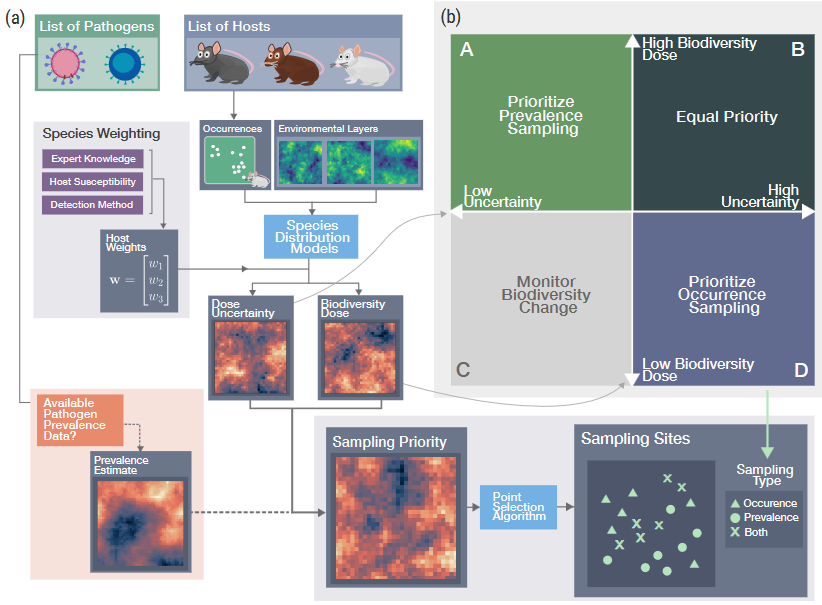
Wildlife disease surveillance is expensive, and for most of the globe there is no actionable information on pathogen prevalence in host populations. Where data exist they have largely been collected opportunistically, without reference to the known distributions of hosts of zoonotic pathogens.
This protocol adapts the Biodiversity Observation Network concept from biodiversity monitoring to biosurveillance. Local host composition is summarised as a biodiversity dose, a weighted average of habitat suitability scores from species distribution models capturing both likely presence and relative importance in transmission. Uncertainty extracted from the same models identifies where host occurrence sampling would most improve baseline predictions. An adaptive priority score balances discovery sampling in high-uncertainty regions against prevalence sampling where dose is high, and balanced-acceptance sampling then generates spatially balanced sites rather than clustering within autocorrelated priority areas.
Two case studies on Hantaviridae and Arenaviridae in rodents demonstrate the range, India as a data-poor context calling for discovery sampling and South Korea as a data-rich one supporting spatially explicit prevalence estimates. The framework keeps the distinction between hazard and realised risk explicit throughout.
Outbreak surveillance at UKHSA
From 2021 to 2022 I was a Senior Analyst in the Outbreak Surveillance Team at the UK Health Security Agency, working on the emergence of the SARS-CoV-2 Omicron variant and the 2022 mpox outbreak. I compiled and managed the national Omicron line list, which made the early estimates of vaccine effectiveness against Omicron possible, and contributed to the investigation of the first UK mpox cases without travel history.
Comparative transmission of SARS-CoV-2 Omicron (B.1.1.529) and Delta (B.1.617.2) variants and the impact of vaccination: national cohort study, England
Allen H, Tessier E, Turner C, Anderson C, Blomquist P, Simons D, et al.
Preprint, 2022 · Epidemiology and Infection, 2023 · PDF
COVID-19 vaccine effectiveness against the omicron (BA.2) variant in England
Kirsebom FCM, Andrews N, Stowe J, Toffa S, Sachdeva R, Gallagher E, et al.
Preprint, · The Lancet Infectious Diseases, 2022 · PDF (preprint)
Community transmission of monkeypox in the United Kingdom, April to May 2022
Vivancos R, Anderson C, Blomquist P, Balasegaram S, Bell A, Bishop L, …, Simons D, et al.
Eurosurveillance, 2022 · PDF
Summary
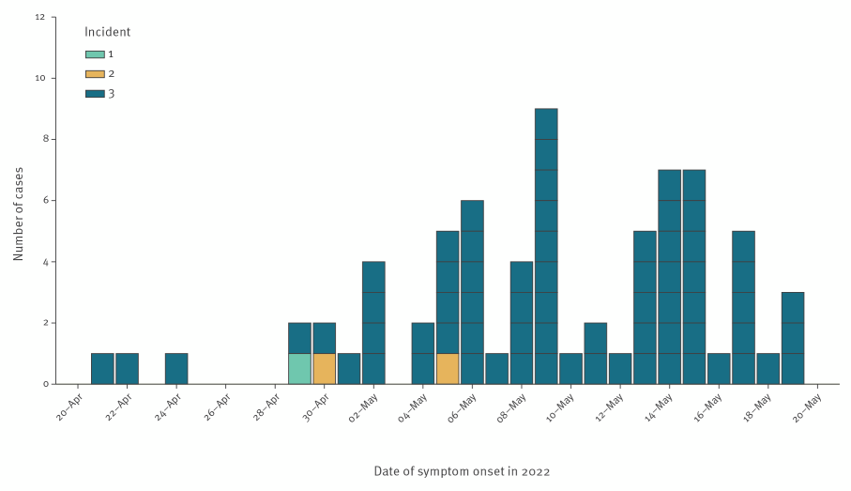
Every previously reported United Kingdom mpox case, seven in total, had been imported or was a household or healthcare contact of an imported case. In May 2022 cases began to appear in people with no documented travel to endemic countries, which implied sustained transmission within the country.
This rapid communication in Eurosurveillance describes the outbreak as it was being investigated, covering 72 laboratory-confirmed cases with known symptom onset between 20 April and 25 May 2022. It sets out the case definitions in use, the epidemiological links between clusters, the demographic and exposure characteristics of cases, and the contact tracing response, including the incubation period of up to 21 days that shaped the follow-up interval.
Publication during an active outbreak serves a different function from retrospective analysis. The value was in giving other countries an early case definition and transmission picture while their own investigations were beginning.
Covid-19 Vaccine Effectiveness against the Omicron (B.1.1.529) Variant
Andrews N, Stowe J, Kirsebom F, Toffa S, Rickeard T, Gallagher E, …, Simons D, et al.
Preprint, 2021 · New England Journal of Medicine, 2022 · PDF (preprint)
Enhancing epidemiological surveillance of the emergence of the SARS-CoV-2 Omicron variant using spike gene target failure data, England, 15 November to 31 December 2021
Blomquist PB, Bridgen J, Bray N, O’Connell AM, West D, Groves N, …, Simons D, et al.
Eurosurveillance, 2022 · PDF
mpox in endemic regions
The 2022 outbreak drew attention to a disease long under-reported where it is endemic. A commentary in the International Journal of Infectious Diseases proposes two drivers of the rise in outbreaks: growing synanthropic rodent populations in West and Central Africa, and a population without immunity 45 years after smallpox vaccination ended.
The reservoir of mpox virus is still unidentified. Virus has been isolated from wild animals twice, and antibodies have been found in several further species.
Increased outbreaks of monkeypox highlight gaps in actual disease burden in Sub-Saharan Africa and in animal reservoirs
Haider N, Guitian J, Simons D, Asogun D, Ansumana R, Honeyborne I, et al.
International Journal of Infectious Diseases, 2022
Summary
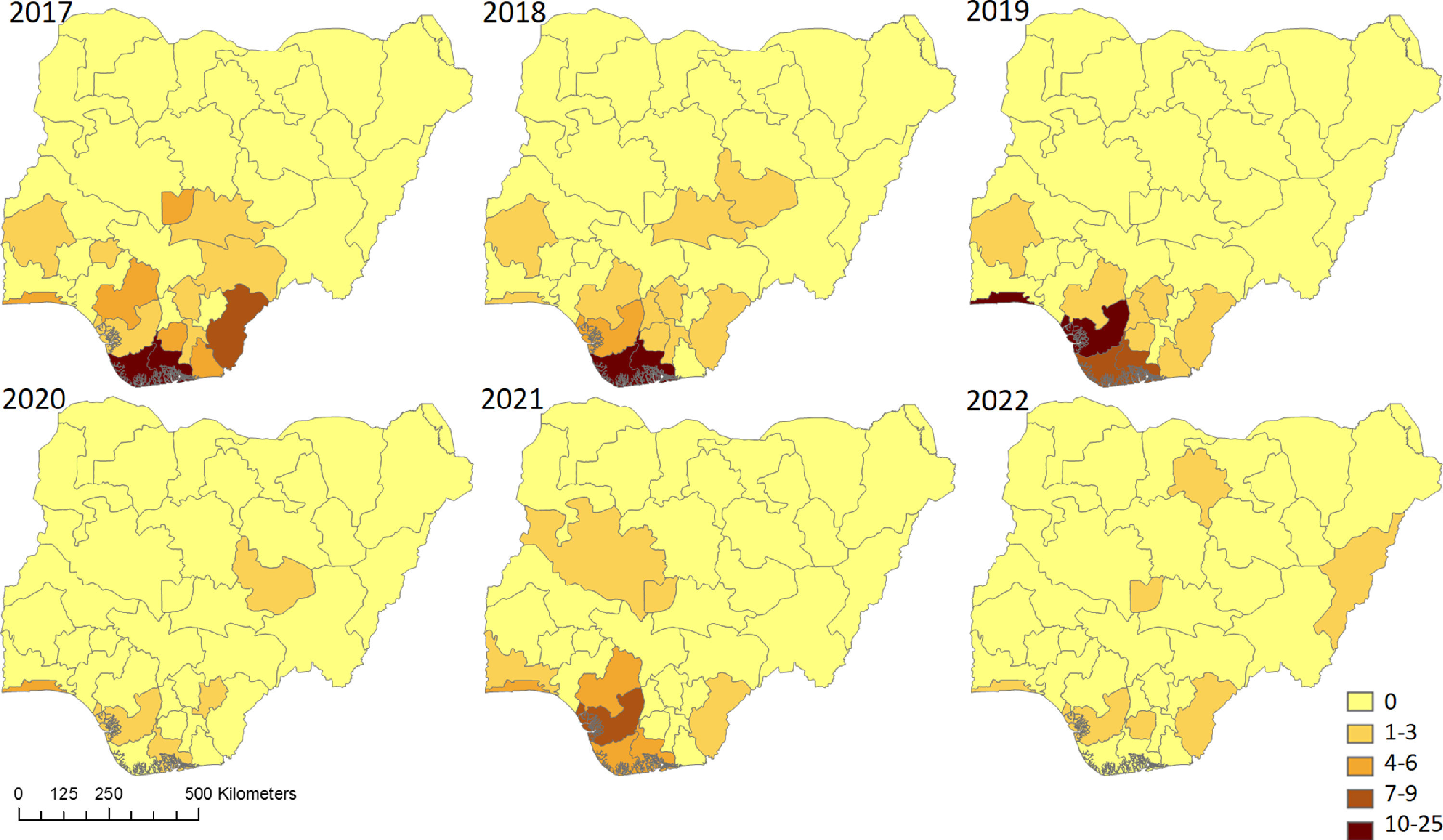
More than 400 mpox cases were detected across many countries within a month in May 2022. The outbreak in Europe, the Americas and Australia raised a question about what had changed in the endemic range beforehand, where burden is poorly characterised and the animal reservoir remains unidentified.
This paper sets out the research gaps and two hypotheses connecting them to the global outbreak. The first is that synanthropic rodent populations in West and Central Africa have increased in recent years, raising human-rodent contact and hence mpox virus transmission to people. The second is that, roughly 45 years after routine smallpox vaccination ended, the immunologically naive population has grown large and interconnected enough to sustain human-to-human transmission that would previously have died out.
Under both, the epidemic outside Africa is a consequence of increased local transmission within it. Testing them requires re-estimated basic and effective reproduction numbers in different populations, and surveillance capable of describing the reservoir rather than only the human cases.
COVID-19 modelling with CMMID
In 2020 and 2021 I was part of the COVID-19 working group of the Centre for Mathematical Modelling of Infectious Diseases at the London School of Hygiene and Tropical Medicine. The group’s models informed the response in the UK and internationally: early spread and under-ascertainment, contact tracing, testing and quarantine, travel, social contacts under restrictions, and the value of vaccination.
Show the 21 papers
Modelling the medium-term dynamics of SARS-CoV-2 transmission in England in the Omicron era
Barnard RC, Davies NG, Centre for Mathematical Modelling of Infectious Diseases COVID-19 working group, Munday JD, Lowe R, Knight GM, …, Simons D, et al.
Preprint, · Nature Communications, 2022 · PDF
The local burden of disease during the first wave of the COVID-19 epidemic in England: estimation using different data sources from changing surveillance practices
Nightingale ES, Abbott S, Russell TW, CMMID Covid-19 Working Group, Rees EM, Eggo RM, …, Simons D, et al.
Preprint, · BMC Public Health, 2022 · PDF
Analysis of temporal trends in potential COVID-19 cases reported through NHS Pathways England
Leclerc QJ, Nightingale ES, Abbott S, CMMID COVID-19 Working Group, Rees EM, Eggo RM, …, Simons D, et al.
Preprint, · Scientific Reports, 2021 · PDF
Contact tracing is an imperfect tool for controlling COVID-19 transmission and relies on population adherence
Davis EL, Lucas TCD, Borlase A, Pollington TM, Abbott S, Ayabina D, …, Simons D, et al.
Nature Communications, 2021 · PDF
Estimating the effectiveness of routine asymptomatic PCR testing at different frequencies for the detection of SARS-CoV-2 infections
The SAFER Investigators and Field Study Team, Hellewell J, The Crick COVID-19 Consortium, CMMID COVID-19 working group, Russell TW, Beale R, et al.
Preprint, · BMC Medicine, 2021 · PDF
Implications of the school-household network structure on SARS-CoV-2 transmission under school reopening strategies in England
Munday JD, Sherratt K, Meakin S, Endo A, Pearson CAB, Hellewell J, …, Simons D, et al.
Preprint, · Nature Communications, 2021 · PDF
Importance of patient bed pathways and length of stay differences in predicting COVID-19 hospital bed occupancy in England
Leclerc QJ, Fuller NM, Keogh RH, Diaz-Ordaz K, Sekula R, Semple MG, …, Simons D, et al.
BMC Health Services Research, 2021 · PDF
Projecting contact matrices in 177 geographical regions: An update and comparison with empirical data for the COVID-19 era
Prem K, Zandvoort Kv, Klepac P, Eggo RM, Davies NG, Centre for the Mathematical Modelling of Infectious Diseases COVID-19 Working Group, Cook AR, Jit M
Preprint, · PLOS Computational Biology, 2021 · PDF
Quarantine and testing strategies in contact tracing for SARS-CoV-2: a modelling study
Quilty BJ, Clifford S, Hellewell J, Russell TW, Kucharski AJ, Flasche S, …, Simons D, et al.
Preprint, · The Lancet Public Health, 2021 · PDF (preprint)
Strategies to reduce the risk of SARS-CoV-2 importation from international travellers: modelling estimations for the United Kingdom, July 2020
Clifford S, Quilty BJ, Russell TW, Liu Y, Chan YWD, Pearson CAB, et al.
Preprint, · Eurosurveillance, 2021 · PDF (preprint)
The impact of local and national restrictions in response to COVID-19 on social contacts in England: a longitudinal natural experiment
CMMID COVID-19 working group, Jarvis CI, Gimma A, van Zandvoort K, Wong KLM, Edmunds WJ
BMC Medicine, 2021 · PDF
The impact of non-pharmaceutical interventions on SARS-CoV-2 transmission across 130 countries and territories
CMMID COVID-19 Working Group, Liu Y, Morgenstern C, Kelly J, Lowe R, Jit M
Preprint, · BMC Medicine, 2021 · PDF
The importance of saturating density dependence for population-level predictions of SARS-CoV-2 resurgence compared with density-independent or linearly density-dependent models, England, 23 March to 31 July 2020
Nightingale ES, Brady OJ, CMMID Covid-19 working group, Yakob L
Preprint, · Eurosurveillance, 2021 · PDF
The importance of supplementary immunisation activities to prevent measles outbreaks during the COVID-19 pandemic in Kenya
LSHTM CMMID COVID-19 Working Group, Mburu CN, Ojal J, Chebet R, Akech D, Karia B, et al.
Preprint, · BMC Medicine, 2021 · PDF
The potential health and economic value of SARS-CoV-2 vaccination alongside physical distancing in the UK: a transmission model-based future scenario analysis and economic evaluation
Sandmann FG, Davies NG, Vassall A, Edmunds WJ, Jit M, Sun FY, …, Simons D, et al.
Preprint, · The Lancet Infectious Diseases, 2021 · PDF (preprint)
Changing travel patterns in China during the early stages of the COVID-19 pandemic
Gibbs H, Liu Y, Pearson CAB, Jarvis CI, Grundy C, Quilty BJ, …, Simons D, et al.
Preprint, · Nature Communications, 2020 · PDF
Effectiveness of isolation, testing, contact tracing, and physical distancing on reducing transmission of SARS-CoV-2 in different settings: a mathematical modelling study
Kucharski AJ, Klepac P, Conlan AJK, Kissler SM, Tang ML, Fry H, …, Simons D, et al.
Preprint, · The Lancet Infectious Diseases, 2020 · PDF (preprint)
Reconstructing the early global dynamics of under-ascertained COVID-19 cases and infections
Russell TW, Golding N, Hellewell J, Abbott S, Wright L, Pearson CAB, …, Simons D, et al.
Preprint, · BMC Medicine, 2020 · PDF
The contribution of asymptomatic SARS-CoV-2 infections to transmission on the Diamond Princess cruise ship
Emery JC, Russell TW, Liu Y, Hellewell J, Pearson CA, CMMID COVID-19 Working Group, …, Simons D, et al.
Preprint, · eLife, 2020 · PDF
The impact of COVID-19 control measures on social contacts and transmission in Kenyan informal settlements
Quaife M, van Zandvoort K, Gimma A, Shah K, McCreesh N, Prem K, …, Simons D, et al.
Preprint, · BMC Medicine, 2020 · PDF
Using a real-world network to model localized COVID-19 control strategies
Firth JA, Hellewell J, Klepac P, Kissler S, CMMID COVID-19 Working Group, Jit M, …, Simons D, et al.
Nature Medicine, 2020 · PDF
COVID-19 preparedness in Africa
In early 2020, as part of PANDORA-ID-NET support to the Africa Centres for Disease Control and Prevention, I estimated where in Africa infections imported from China were likely to appear first, and contributed to a review of preparedness on the continent drawn from earlier epidemics.
Is Africa prepared for tackling the COVID-19 (SARS-CoV-2) epidemic. Lessons from past outbreaks, ongoing pan-African public health efforts, and implications for the future
Kapata N, Ihekweazu C, Ntoumi F, Raji T, Chanda-Kapata P, Mwaba P, …, Simons D, et al.
International Journal of Infectious Diseases, 2020
Passengers’ destinations from China: low risk of Novel Coronavirus (2019-nCoV) transmission into Africa and South America
Haider N, Yavlinsky A, Simons D, Osman AY, Ntoumi F, Zumla A, Kock R
Epidemiology and Infection, 2020 · PDF
Clinical work
From 2019 to 2022 I was a resident doctor at the Hospital for Tropical Diseases, University College London Hospitals, and worked clinically through the pandemic. I assisted with the RECOVERY trial, the randomised platform trial that identified effective treatments for COVID-19 while the pandemic was under way, by enrolling patients at University College London Hospitals. With the UCLH Find and Treat team I carried out health needs assessments for people experiencing homelessness who were housed temporarily in hotels and hostels during the pandemic. With colleagues I also evaluated the 4C Mortality Score, a risk score for patients admitted with COVID-19, in UK hospitals, and contributed to a commentary on protecting sickle cell disease services in African countries during the pandemic.
Evaluation of the Implementation of the 4C Mortality Score in United Kingdom hospitals during the second pandemic wave
Blunsum AE, Perkins JS, Arshad A, Bajpai S, Barclay-Elliott K, Brito-Mutunayagam S, …, Simons D, et al.
Preprint, 2021 · PDF (preprint)
Mitigating the effect of the COVID-19 pandemic on sickle cell disease services in African countries
Dexter D, Simons D, Kiyaga C, Kapata N, Ntoumi F, Kock R, Zumla A
The Lancet Haematology, 2020
Last updated 5 October 2026