SCAPES, Nigeria
Cross-scale dynamics of Lassa virus spillover within human-driven ecosystems
SCAPES (Scaling Lassa Virus Dynamics within Anthropogenic Ecosystems) asks how people’s land use and movement shape their contact with the rodent reservoir of Mammarenavirus lassaense, and how that contact scales up to spillover across a landscape. It follows people, rodents and land cover together in nine villages in Benue, Ebonyi and Cross River states, Nigeria, with fieldwork since late 2023.
The study is a five-year NSF Ecology and Evolution of Infectious Diseases grant, led by Sagan Friant at Pennsylvania State University with Lina Moses, David Redding and partners in Nigeria. I am a collaborator on the project, working on the human and rodent ecology that moderates the risk of infection.
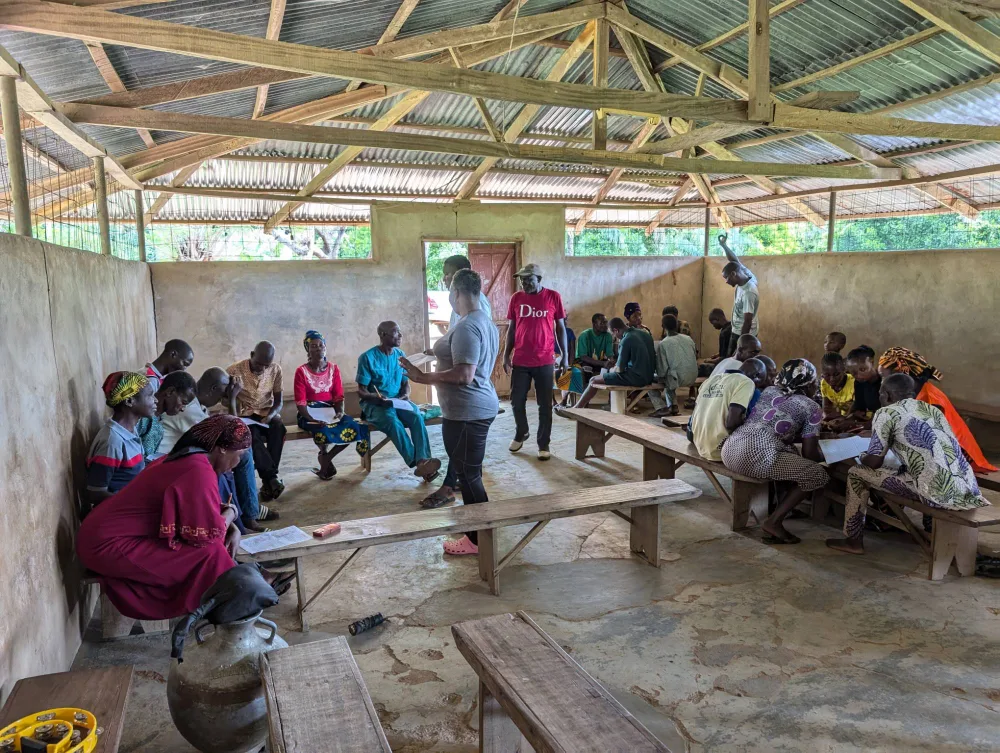
9 villages in Benue, Ebonyi and Cross River states
1,874 people tested for Lassa virus antibodies
1,200+ rodents and shrews sampled
Progress
| Workstream | Status |
|---|---|
| Study protocol | Published, Wellcome Open Research |
| Site selection | Published as SiteTool, Ecography |
| Participatory rural appraisal | Published, EcoHealth |
| Baseline human serosurvey | Published, PLOS Neglected Tropical Diseases |
| Human movement (GPS tracking and activity diaries) | Data collection complete; paper in preparation |
| Rodent sampling | More than 1,200 rodents and shrews sampled; laboratory analysis ongoing |
| Land cover from drone imagery | Classification in preparation |
Later stages link rodent abundance, human movement and seroconversion in an interface model, test it in independent villages, and design interventions with the communities.
Findings so far
- Exposure is local. Among 1,874 people tested, Lassa virus seroprevalence was 3.2% overall but ranged from under 1% to over 6% between neighbouring villages, and none of 21 candidate risk factors showed a strong or consistent association. Trial site selection needs active serosurveillance, not regional incidence maps. Paper.
- Contact follows land use. Communities reported more Mastomys activity after land clearing and the rice harvest, more movement between fields and homes where houses are interspersed with farmland, and contact that differs with gendered agricultural work. Paper.
Data and code
- Project hub. The SCAPES repository indexes the project’s public code, data releases and protocols. Identifiable human data, including GPS tracks and household locations, are held privately under the study’s ethical approvals.
- Baseline serosurvey. Code on GitHub; aggregated data on Zenodo.
- SiteTool. The Shiny application used to select the field sites.
- Project website. Field sites and collaborators are on the SCAPES story map.
Preliminary serology and the project’s aims were presented at the Second Lassa Fever International Conference, Abidjan, 2025. Poster.
Papers
A One Health trial design to accelerate Lassa fever vaccines
Simons D, Watson-Jones D, Manno D, Friant S
Nature Medicine, 2026 · PDF
Summary
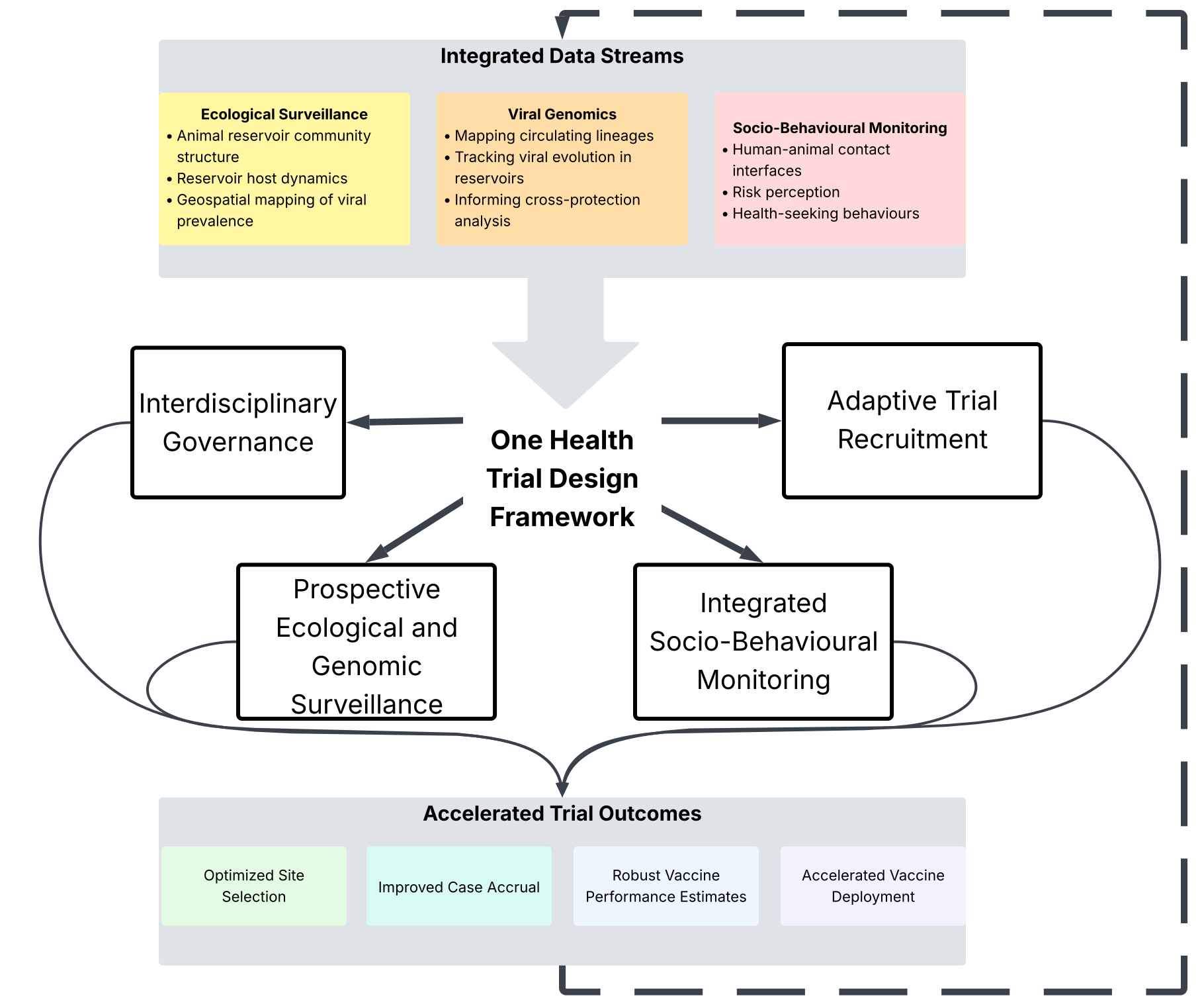
Vaccine trials for zoonotic pathogens face a structural problem. Efficacy endpoints depend on incident infection at trial sites, and spillover from wildlife is spatially and temporally unpredictable. For Lassa fever this uncertainty has slowed candidate vaccines through the pipeline.
This commentary in Nature Medicine sets out a One Health Trial Design in which ecological and social data are integrated at three stages. Viral phylogenetic diversity across the reservoir’s range informs antigen selection. Reservoir distribution models and human-rodent contact data support the choice of sites where attack rates will be sufficient. Heterogeneity in exposure, from household rodent contact to occupation, enters the evaluation of vaccine performance.
Lassa fever is the case study, but the framework is generic to pathogens with a wildlife reservoir and offers a template for preparedness against priority zoonoses.
Local Knowledge of Land Use Effects on Human-Rodent Interfaces in Lassa-Endemic Nigeria
Harden C, Eziechina S, Ifebueme NM, Simons D, Moses L, Redding DW, Friant S
EcoHealth, 2026
Summary
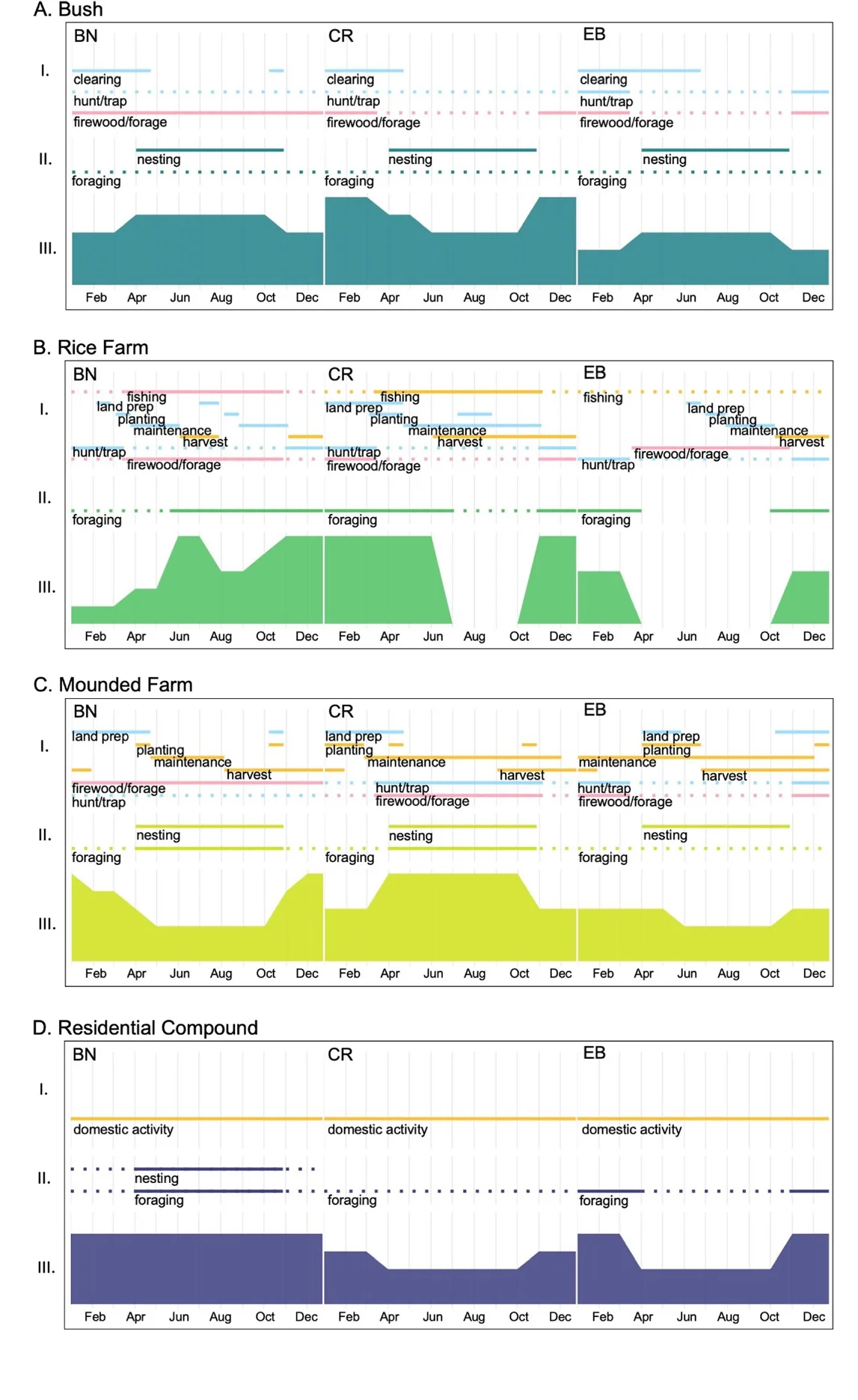
Human contact with Mastomys spp., the reservoir of Mammarenavirus lassaense, is thought to be shaped by settlement pattern and agricultural land use, but how communities perceive and experience that contact had not been characterised across settings in Lassa-endemic Nigeria.
Participatory rural appraisal at three villages with different settlement patterns and landscape structure summarised land cover and agricultural practice, characterised human land use within each land cover type, and identified the types and frequency of contact with suspected Mastomys spp.
All villages reported increased Mastomys activity after seasonal land clearing and the rice harvest. Movement between fields and residential compounds was reported more often where homes were interspersed with farmland. Contact was common in both households and fields, and differed with gendered agricultural duties, suggesting underemphasised pathways for exposure in agricultural settings.
Local heterogeneity in Lassa fever serology in rural Nigeria: Implications for vaccine trial site selection
Simons D, Harden C, Imirzian N, Thompson KET, Ifebueme NM, Eziechina S, et al.
Preprint, 2025 · PLOS Neglected Tropical Diseases, 2026
Summary
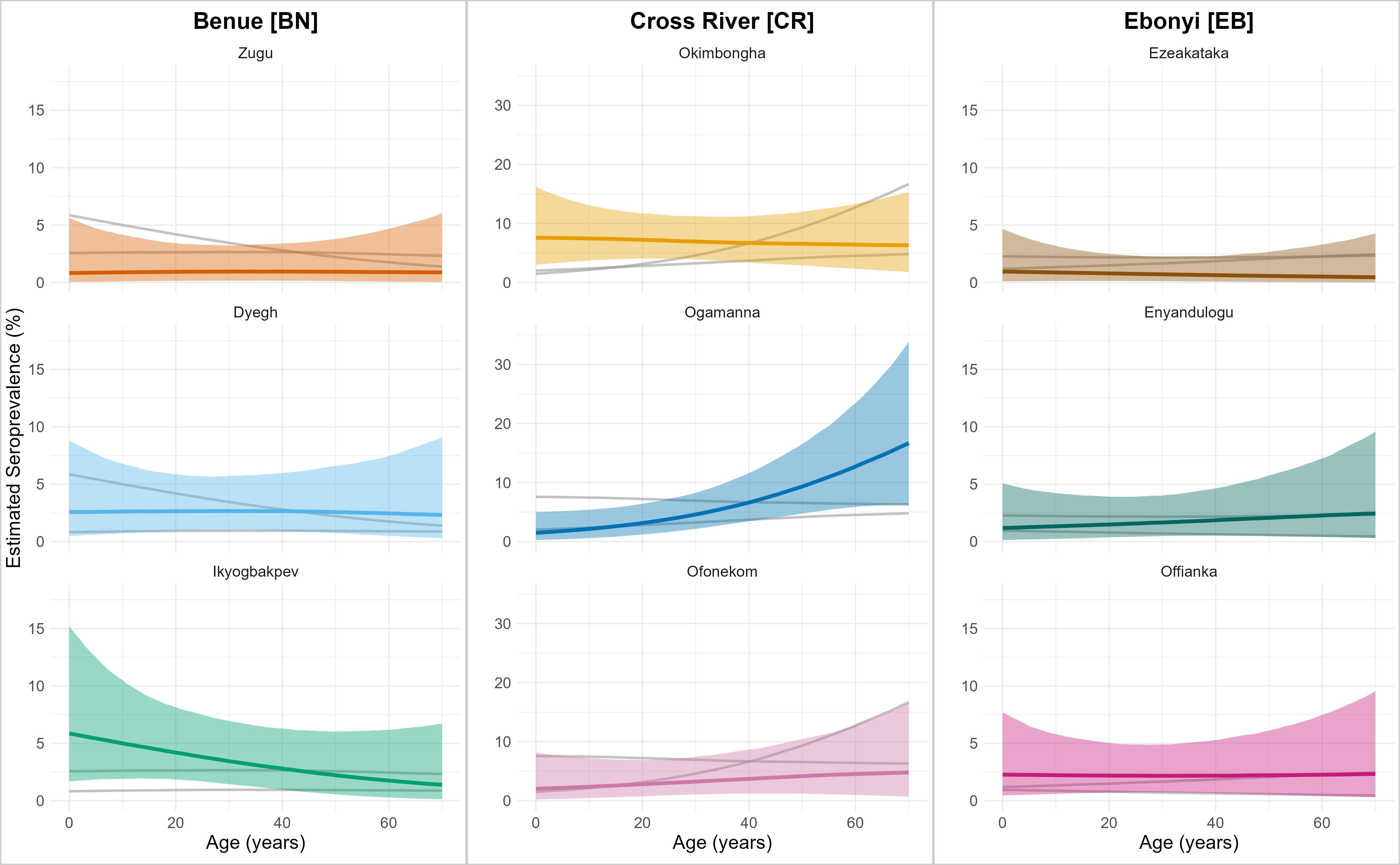
Lassa virus vaccine candidates entering efficacy trials need sites with ongoing transmission, but spillover is unpredictable and passive case detection at sentinel hospitals misses mild infection and asymptomatic seroconversion. This cross-sectional serosurvey estimates exposure directly across nine villages in Benue, Ebonyi and Cross River states, Nigeria.
Among 1,874 participants tested for LASV IgG by ELISA, overall seroprevalence was 3.2%, with marked fine-scale heterogeneity: village estimates ranged from under 1% to over 6% between communities in close proximity. Of 21 candidate risk factors, including rodent consumption, agricultural practice and household environment, none showed strong or consistent association, plausibly reflecting the low event rate and near-ubiquitous exposure, with 94% of households reporting rodent entry.
Age-seroprevalence curves diverged by village, some rising monotonically with age as expected under stable endemic exposure, others peaking in younger groups consistent with recent focal transmission. Exposure at this scale is not predictable from regional incidence maps or from behaviour, so trial site selection needs active human serosurveillance alongside longitudinal reservoir monitoring.
Scaling Lassa Virus Dynamics within Anthropogenic Ecosystems (SCAPES) Study Protocol: a mixed-methods observational cohort study of humans, rodents, and landscapes in Nigeria.
Friant S, Simons D, Harden C, Imirzian N, Bjornstad O, Gibb R, et al.
Preprint, 2025 · Wellcome Open Research, 2026 · PDF
Summary
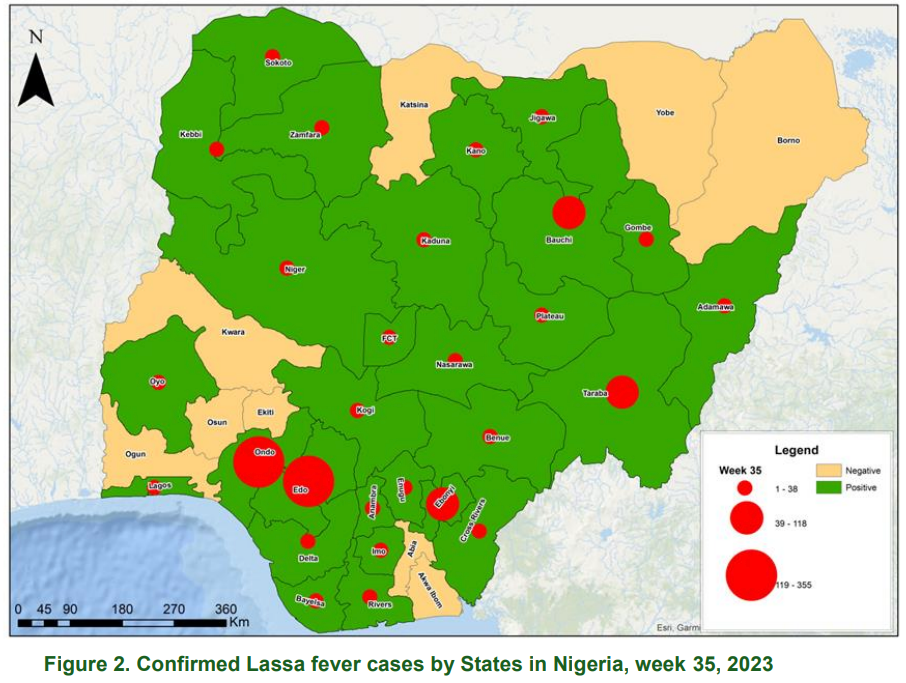
Lassa fever epidemics are dominated by repeated spillover from rodent reservoirs to people in rural settings, which makes Lassa mammarenavirus an unusually tractable system for studying zoonotic transmission. Inference is limited because ecological and behavioural data are rarely collected at the same scale in the same places.
This protocol sets out the ecological and anthropological components of SCAPES, a five-year NSF EEID study in Ebonyi, Benue and Cross River states, Nigeria. It specifies longitudinal rodent trapping with pathogen assay, household and individual data collection on the activities generating human-reservoir contact, and cross-sectional human serology, under a sampling frame that aligns the components spatially.
The design allows fine-scale field measurements of exposure to be propagated into broad-scale risk models, addressing how risk estimated at one scale relates to the processes operating at another. Publishing the protocol fixes the analysis plan before the data accrue.
The socio-economic shield limits Lassa virus spillover in urban West Africa
Simons D
Preprint, 2025 · Epidemiology and Infection, 2026 · PDF
Summary
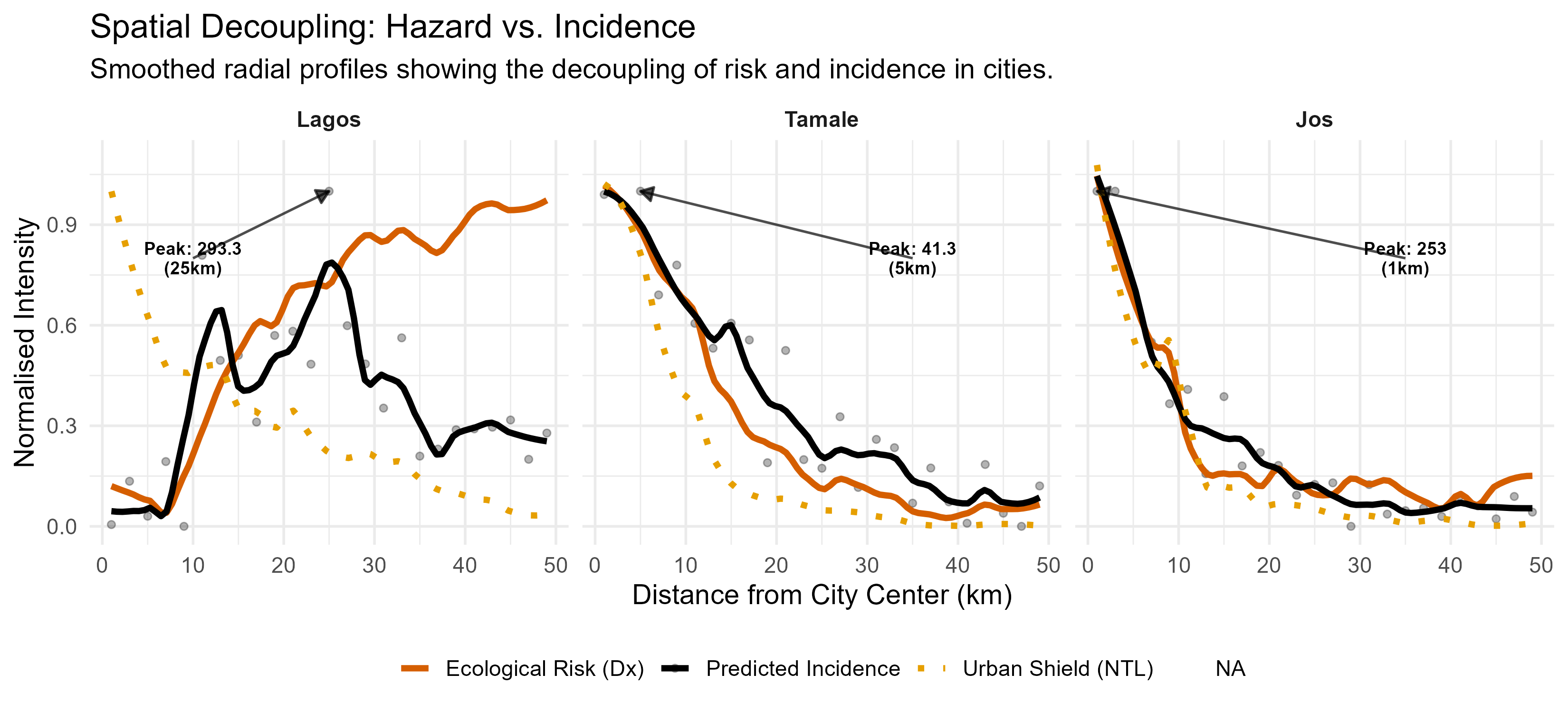
Spatial models of Lassa fever risk have relied on abiotic climatic envelopes for the reservoir host, the natal multimammate mouse Mastomys natalensis, and so predict a rural disease. This paper assesses what changes when biotic interactions and anthropogenic land use are added to the reservoir’s realised niche.
An integrated multi-species occupancy model quantifies co-occurrence between M. natalensis and the invasive commensals Rattus rattus and Mus musculus. With those interactions in the model, M. natalensis persists in peri-urban and human-modified landscapes rather than being competitively excluded, so ecological hazard extends to the urban fringe.
Realised spillover is then modelled with a socio-economic shield, proxied by night-time lights, that dampens transmission non-linearly with urban infrastructure. Hazard and incidence decouple across the city profile. Adjusting for seroreversion and shielding gives a regional burden near 2.6 million infections a year. Validation against clinical data identifies high-suitability districts in Nigeria, Benin and Togo that report no cases, surveillance gaps produced by structural inequality rather than by absence of hazard.
‘SiteTool’: a ‘Shiny’ application for field site selection and evaluation
Imirzian N, Trebski A, Johnson E, Hewitson M, Simons D, Harden C, Friant S, Redding D
Preprint, 2025 · Ecography, 2026 · PDF (preprint)
Summary
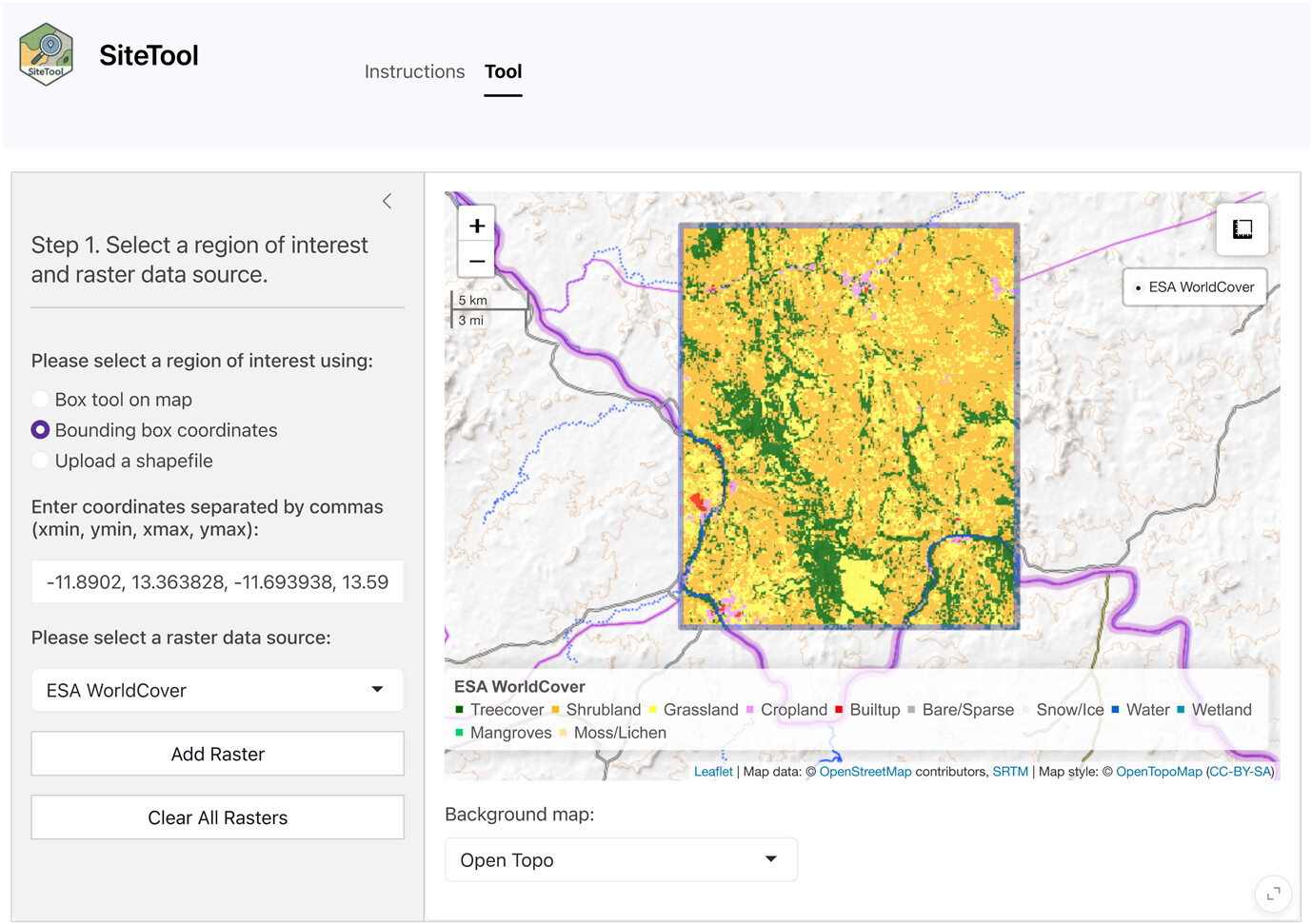
Field studies underpin ecological and epidemiological inference, yet site selection is often haphazard or driven by convenience. Poorly specified sampling designs bias input data and propagate into parameter estimates, which matters particularly when estimating zoonotic risk or species abundance. Remote-sensing layers could inform selection without pilot visits, but working with raw spatial data is a barrier for many field teams.
SiteTool is an open-source R Shiny application that puts that evaluation in a graphical interface. A region of interest is defined by map, bounding box or GeoJSON; candidate sites are generated as random points or extracted as populated places from OpenStreetMap; environmental gradients are queried within a specified radius from default layers such as ESA WorldCover, SRTM elevation and the Human Footprint Index, or from uploaded rasters. Built-in Mann-Whitney U tests compare selected sites against background points, so a design can be checked for environmental bias before fieldwork begins.
The tool structured the sampling frame for SCAPES in Nigeria, where 273 candidate communities within a three-hour drive were evaluated on cropland and grassland cover to span an agricultural gradient under logistical constraint.
Reducing the threats of rodent-borne zoonoses requires an understanding and leveraging of three key pillars: disease ecology, synanthropy, and rodentation
Friant S, Mistrick J, Luis AD, Harden C, Simons D, Fichet-Calvet E, et al.
The Lancet Planetary Health, 2025
Summary
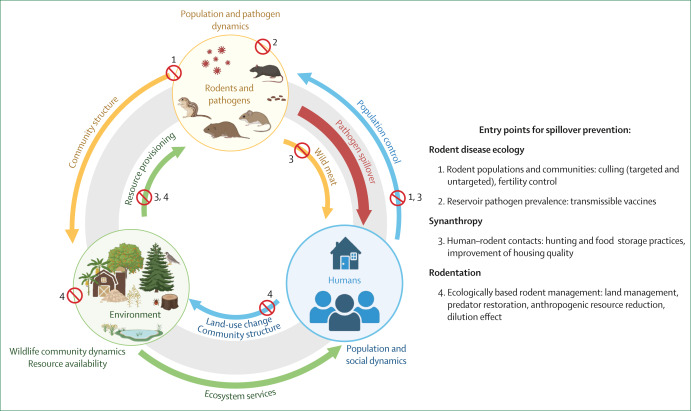
Control of rodent-borne zoonoses has concentrated on treating human disease and on killing rodents, neither of which addresses the processes that bring hosts and people together. Endemic and emerging rodent infections continue to cause substantial morbidity in low-income and middle-income countries.
This Personal View in The Lancet Planetary Health, from the annual Rodent-Borne Zoonoses workshop, organises prevention around three pillars. Disease ecology determines which species carry which pathogens and how infection is maintained. Synanthropy describes the degree to which species live alongside people, and so sets the rate of contact. Rodentation, the growth and spread of commensal rodent populations under human land use, links the first two to anthropogenic change.
A conceptual model maps the interactions and feedbacks between rodent ecology, human behaviour and ecological context, identifying where intervention has immediate and downstream effects. Settlement and land-use change alter predator and resource availability, which modulates rodent populations and thereby spillover, so control designed at the level of the system should outperform reactive rodenticide campaigns.
Last updated 5 October 2026