Earlier work
Projects outside the current programmes, or where my role was more peripheral.
Digital health and smoking
With Olga Perski and colleagues in the UCL Tobacco and Alcohol Research Group, I worked on digital interventions for sustained behaviour change. Two studies used data from a smoking cessation app, and from ecological momentary assessments and sensors, to train machine learning algorithms that classify or predict lapses in people trying to stop smoking. Group-level algorithms performed well, but their performance varied when applied to new individuals.
From March 2020 the same group asked whether smoking changes the risk of SARS-CoV-2 infection, severe COVID-19 and death. Early data suggested a lower prevalence of smoking among patients than expected, and it was unclear whether that reflected biology or poor recording. We produced a rapid evidence review for the Royal College of Physicians, kept a living review up to date as studies appeared, argued for triangulation of methods and preregistration, and compared hospitalisation for COVID-19 with other respiratory viruses in current and former smokers at University College London Hospitals. A planned analysis of the Office for National Statistics COVID-19 Infection Survey has a protocol on the Open Science Framework but was not carried out.
Optimising supervised machine learning algorithms predicting cigarette cravings and lapses for a smoking cessation just-in-time adaptive intervention (JITAI)
Leppin C, Brown J, Garnett C, Kale D, Okpako T, Simons D, Perski O
Preprint, 2025 · PLOS One, 2026
Supervised machine learning to predict smoking lapses from Ecological Momentary Assessments and sensor data: Implications for just-in-time adaptive intervention development
Perski O, Kale D, Leppin C, Okpako T, Simons D, Goldstein SP, Hekler E, Brown J
Preprint, 2024 · PLOS Digital Health, 2024
Classification of Lapses in Smokers Attempting to Stop: A Supervised Machine Learning Approach Using Data From a Popular Smoking Cessation Smartphone App
Perski O, Li K, Pontikos N, Simons D, Goldstein SP, Naughton F, Brown J
Preprint, 2022 · Nicotine and Tobacco Research, 2023
Association of smoking status with hospitalisation for COVID-19 compared with other respiratory viruses a year previous: a case-control study at a single UK National Health Service trust
Simons D, Perski O, Shahab L, Brown J, Bailey R
Preprint, 2020 · F1000Research, 2022 · PDF
Smoking, Nicotine, and COVID-19: Triangulation of Methods and Preregistration Are Required for Robust Causal Inference
Perski O, Simons D, Shahab L, Brown J
Nicotine & Tobacco Research, 2021
Digital health at the age of the Anthropocene
Chevance G, Hekler EB, Efoui-Hess M, Godino J, Golaszewski N, Gualtieri L, …, Simons D, et al.
The Lancet Digital Health, 2020
Smoking and COVID-19: Rapid evidence review for the Royal College of Physicians, London (UK)
Simons D, Brown J, Shahab L, Perski O
Preprint, 2020 · PDF (preprint)
The association of smoking status with SARS‐CoV‐2 infection, hospitalization and mortality from COVID‐19: a living rapid evidence review with Bayesian meta‐analyses (version 7)
Simons D, Shahab L, Brown J, Perski O
Preprint, 2020 · Addiction, 2020 · PDF (preprint)
African swine fever
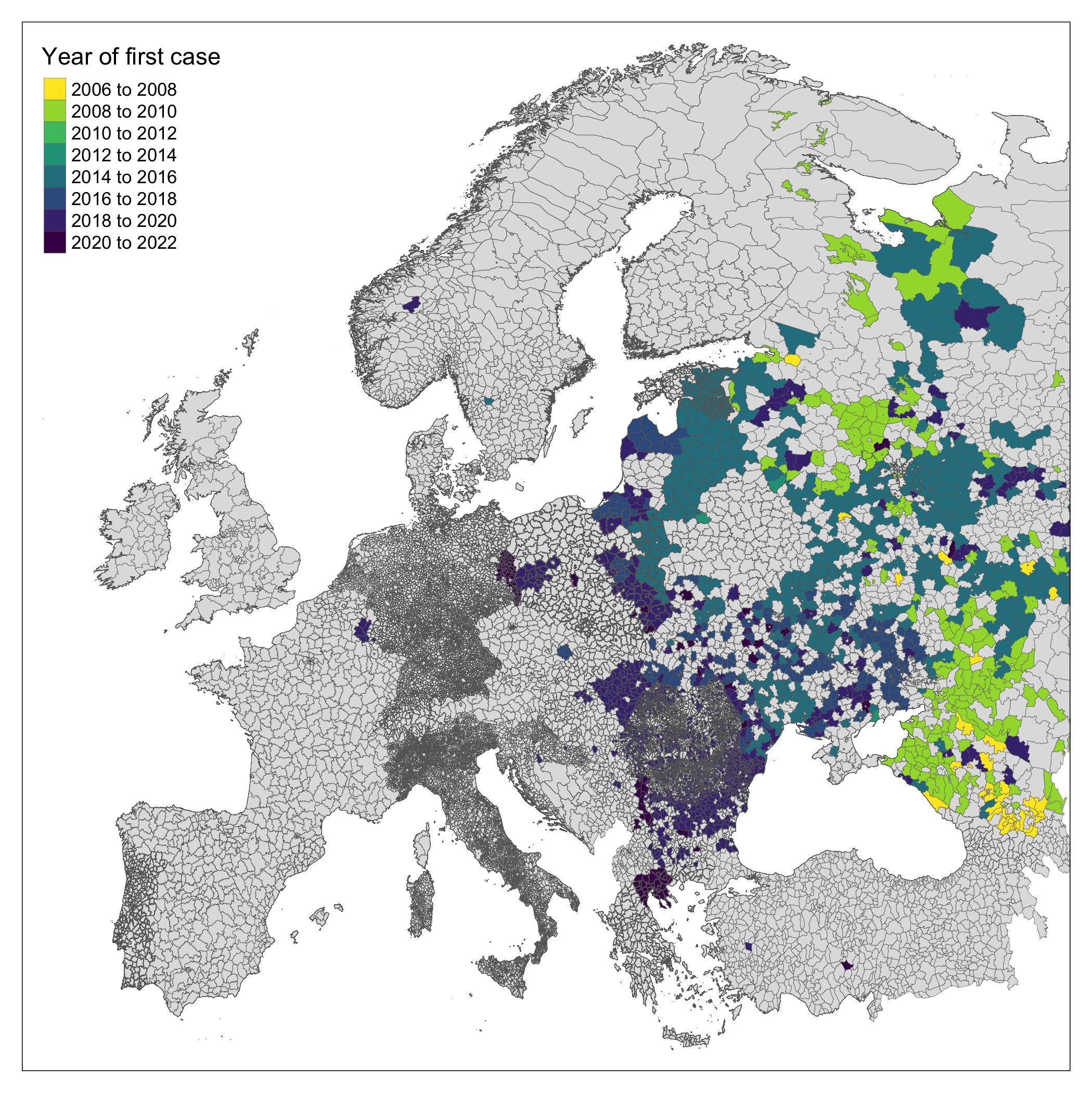
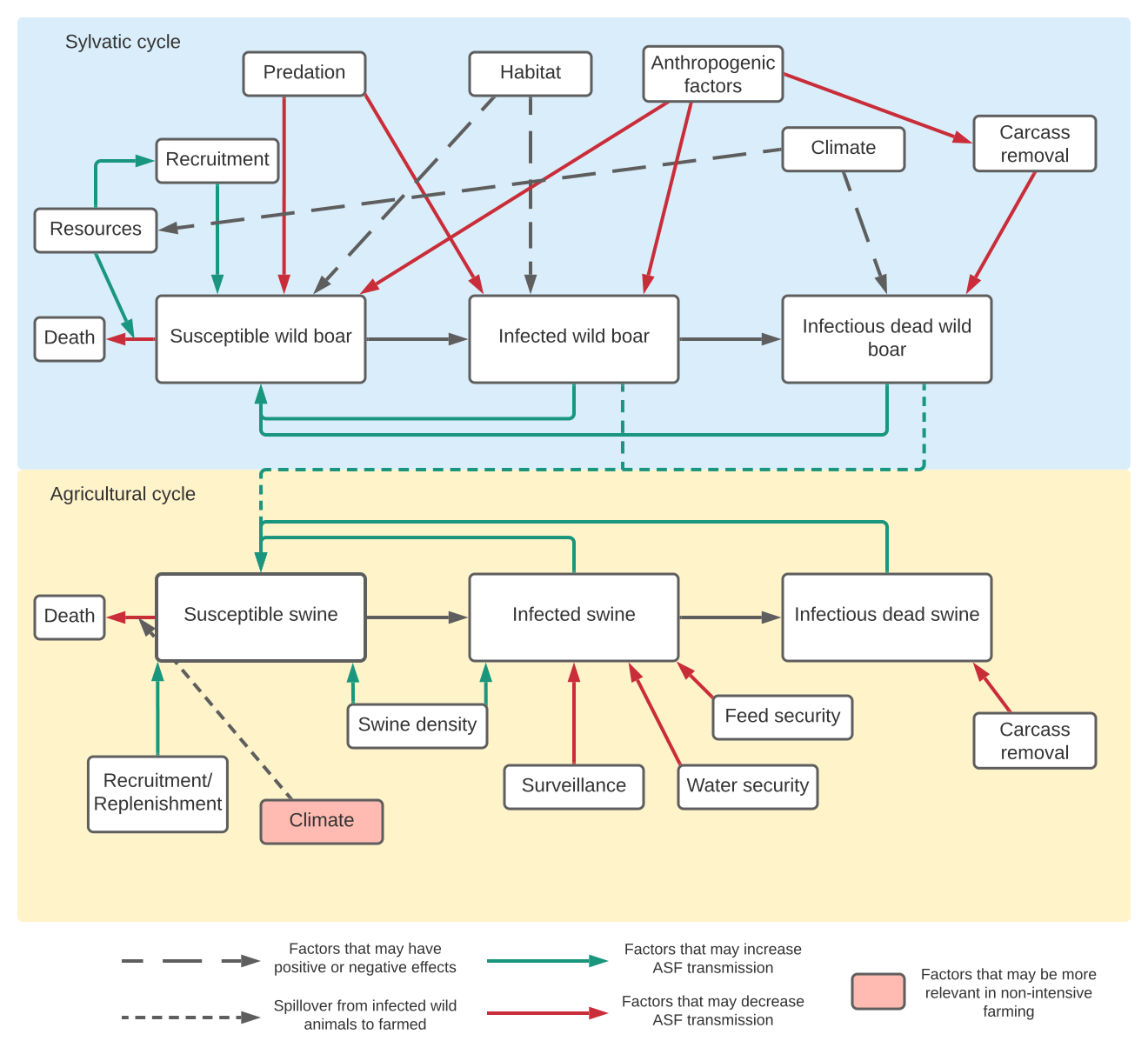
As a visiting researcher at EcoHealth Alliance in 2020, with Noam Ross, I modelled the westward spread of African swine fever through Europe since its introduction to Georgia in 2007. Reports to the World Animal Health Information System were mapped to administrative areas across European countries, and generalised additive models described the invasion front as a non-linear spatial process, to identify conditions that speed up or slow down its spread. The work was not completed.
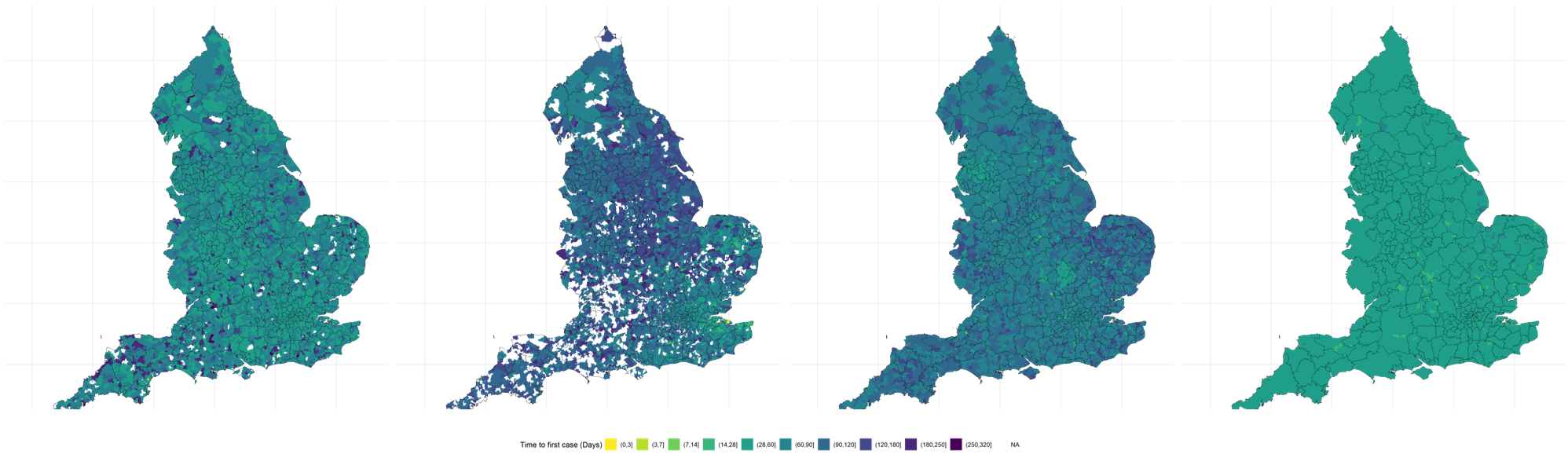
The same method for estimating the speed of spread was applied to SARS-CoV-2 variants in the United Kingdom. That project stopped when access to the data ended, so the figure below is a preliminary result.
Peste des petits ruminants
The Food and Agriculture Organization and the World Organisation for Animal Health aim to eradicate peste des petits ruminants, and eradication depends on serology that performs consistently across host species. I carried out a systematic review of serological assays for the virus, with a meta-analysis of their sensitivity and specificity planned. The work was not completed.
Antimicrobial resistance
I contributed to two cross-sectional studies of antimicrobial resistance on poultry farms on the east coast of Peninsular Malaysia, led by Abdinasir Osman and Sharifo Ali-Elmi .
- Antimicrobial resistance patterns and risk factors associated with Salmonella spp. isolates from poultry farms in the east coast of Peninsular Malaysia: a cross-sectional study. Pathogens, 2021. doi:10.3390/pathogens10091160
- Identification of risk factors associated with resistant Escherichia coli isolates from poultry farms in the east coast of Peninsular Malaysia: a cross-sectional study. Antibiotics, 2021. doi:10.3390/antibiotics10020117
Last updated 6 October 2026