Lassa fever and cities
The socio-economic shield and the urban edge of the reservoir
Spatial risk models for Lassa fever have mostly described the reservoir, Mastomys natalensis, with climatic envelopes, and so predict a rural disease. West African cities are growing fast, and urban land use changes which rodents live where. This work assesses what happens to the predicted risk when the reservoir’s interactions with other rodents and with human infrastructure are modelled directly.
2.6 million estimated Lassa virus infections a year across the endemic region
3 countries with silent districts: Nigeria, Benin and Togo
Approach
An integrated multi-species occupancy model estimates the realised niche of M. natalensis together with two invasive commensals, Rattus rattus and Mus musculus, so that co-occurrence is part of the model rather than ignored. Spillover to people is then modelled with a socio-economic shield, proxied by night-time lights, which dampens transmission non-linearly as urban infrastructure increases.
Findings
- The reservoir reaches the urban fringe. With species interactions in the model, M. natalensis is estimated to persist in peri-urban and human-modified landscapes, not to be excluded by the invasive commensals.
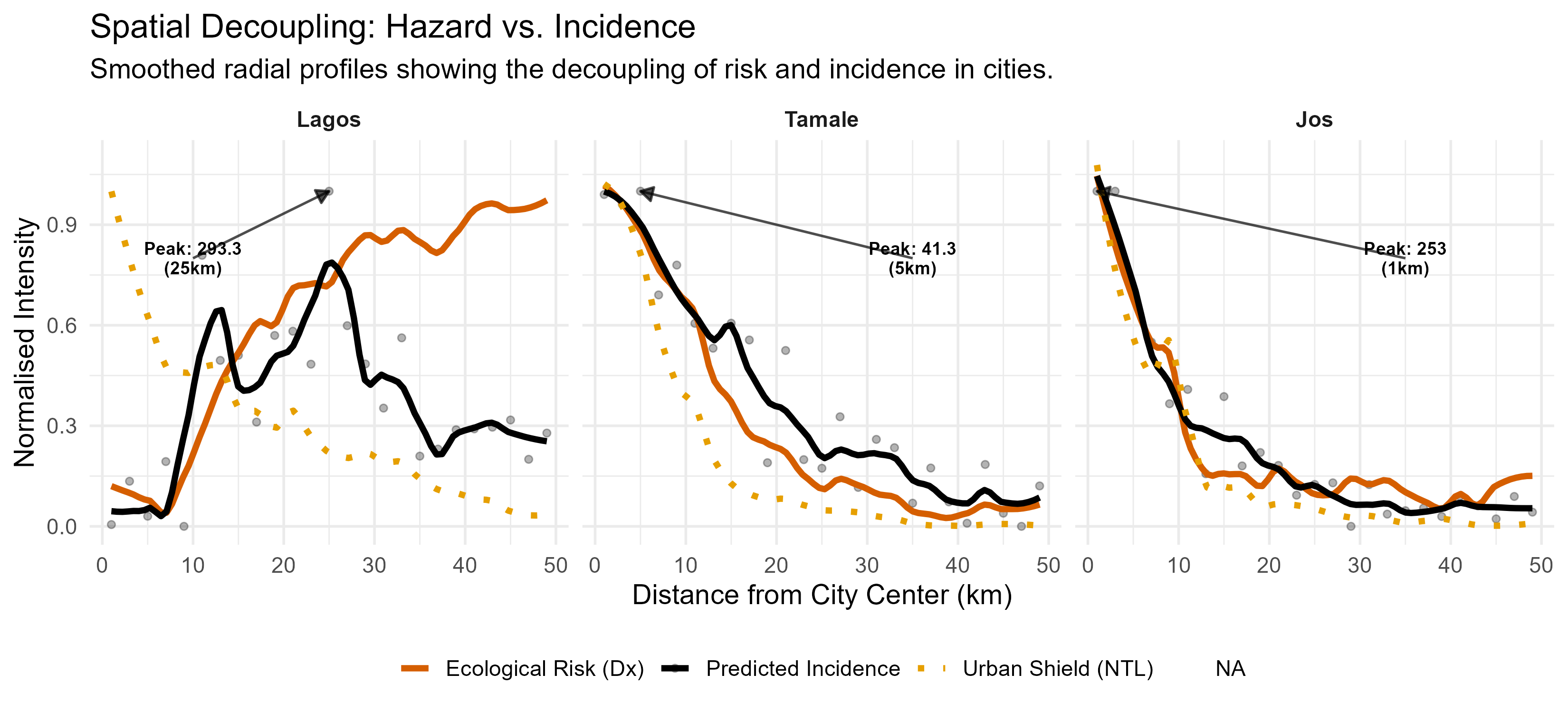
- Hazard and incidence separate across a city. Ecological hazard stays high towards the urban core, but predicted incidence peaks at the periphery, where the shield is weaker.
- About 2.6 million infections a year. Adjusting for seroreversion and shielding gives an estimated regional burden near 2.6 million Lassa virus infections a year.
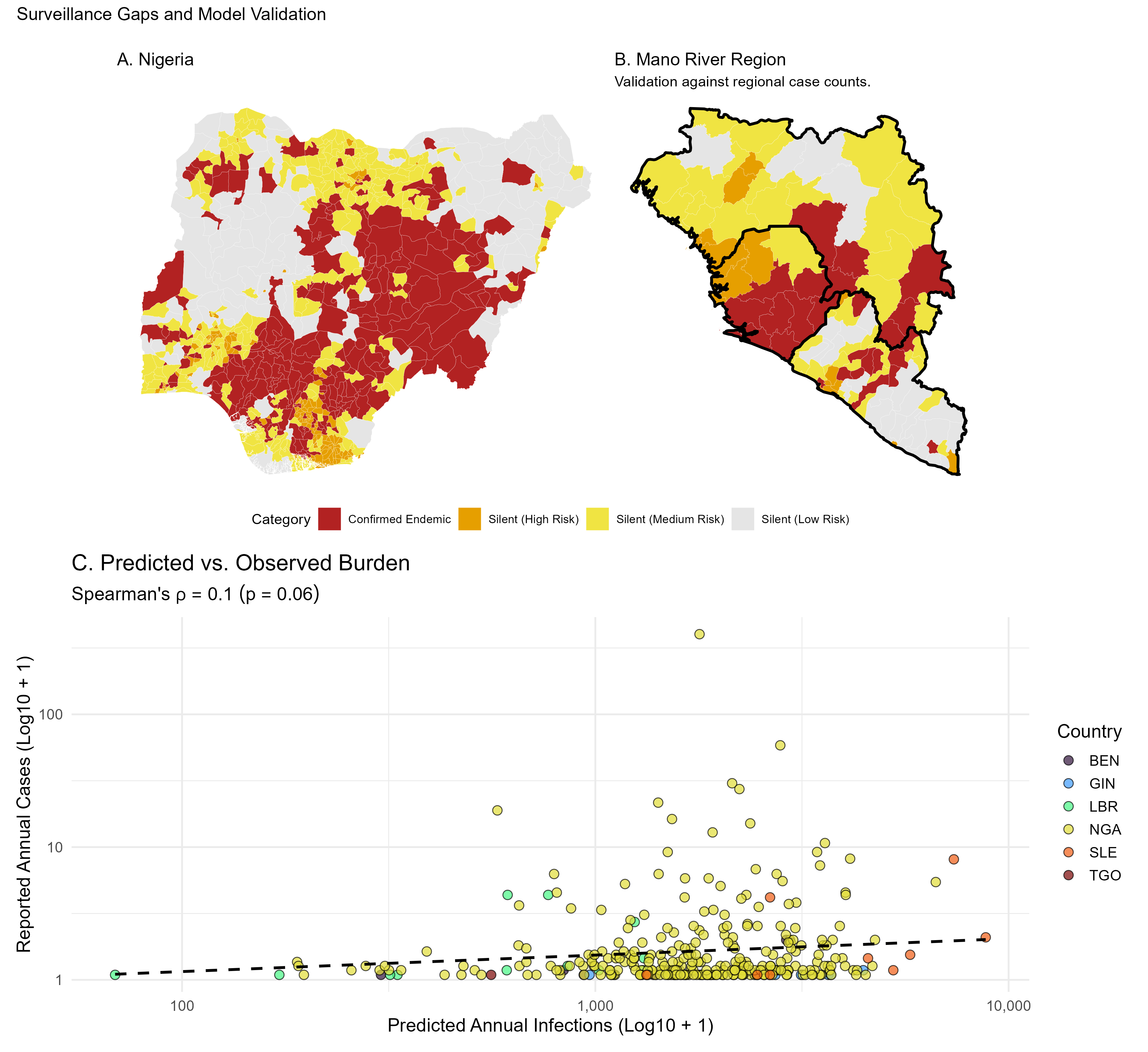
- Silent districts. Validation against clinical data identifies districts in Nigeria, Benin and Togo with high predicted incidence and no reported cases. These are more plausibly surveillance gaps than places without hazard.
The work points to the peri-urban interface as a priority for active surveillance, and it is a starting point for wider work on rodent-borne zoonoses in growing cities. See also Lassa epidemiology and rodent-borne disease ecology.
Code: GitHub
Paper
The socio-economic shield limits Lassa virus spillover in urban West Africa
Simons D
Preprint, 2025 · Epidemiology and Infection, 2026 · PDF
Summary
Spatial models of Lassa fever risk have relied on abiotic climatic envelopes for the reservoir host, the natal multimammate mouse Mastomys natalensis, and so predict a rural disease. This paper assesses what changes when biotic interactions and anthropogenic land use are added to the reservoir’s realised niche.
An integrated multi-species occupancy model quantifies co-occurrence between M. natalensis and the invasive commensals Rattus rattus and Mus musculus. With those interactions in the model, M. natalensis persists in peri-urban and human-modified landscapes rather than being competitively excluded, so ecological hazard extends to the urban fringe.
Realised spillover is then modelled with a socio-economic shield, proxied by night-time lights, that dampens transmission non-linearly with urban infrastructure. Hazard and incidence decouple across the city profile. Adjusting for seroreversion and shielding gives a regional burden near 2.6 million infections a year. Validation against clinical data identifies high-suitability districts in Nigeria, Benin and Togo that report no cases, surveillance gaps produced by structural inequality rather than by absence of hazard.
Last updated 5 October 2026